Plane mirror: drag the object and see that the image is symmetric, upright, virtual, and equal in size to the mirror; field of view of the eye; number of images formed in two angled mirrors n = 360/α − 1
Explore the topic of optics interactively with the plane mirrors simulation and practice learning image formation in a plane mirror. This experiment allows you to observe the characteristics of the image by changing the object and candle position and to reinforce optics rules.
What can you do in this simulation?
You can observe the reflection in the plane mirror by moving the candle to different positions.
You can examine that the image is symmetrical to the mirror, upright, virtual, and of equal size.
You can test the formula for the number of images formed in two angled mirrors by trying different angle options.
You can reinforce your knowledge by answering questions guidedly and get instant feedback.
Basic concepts and formulas
In plane mirrors, the distance of the object to the mirror is equal to the distance of the image to the mirror. The image is virtual, upright, and the same size as the object. The number of images formed in angled systems between two mirrors is calculated with the formula n = 360 / alpha - 1.
How to use?
Open the experiment panel and start the first step to determine the candle position.
Examine the reflection in the mirror and the virtual image by moving the candle to different positions.
Switch to the angled mirror mode and try different angle values.
Complete the experiment by answering the questions and checking your predictions.
Frequently asked questions
Why is the image formed in a plane mirror virtual?
Because light rays do not actually intersect behind the mirror, only their extensions intersect, and therefore the image cannot be formed on a screen.
How is the number of images found in angled mirrors?
The formula is n = 360 / alpha - 1; where alpha represents the angle between the mirrors.
Can the height of the image be different from the height of the object?
In plane mirrors, the height of the object and the height of the image are always equal to each other.
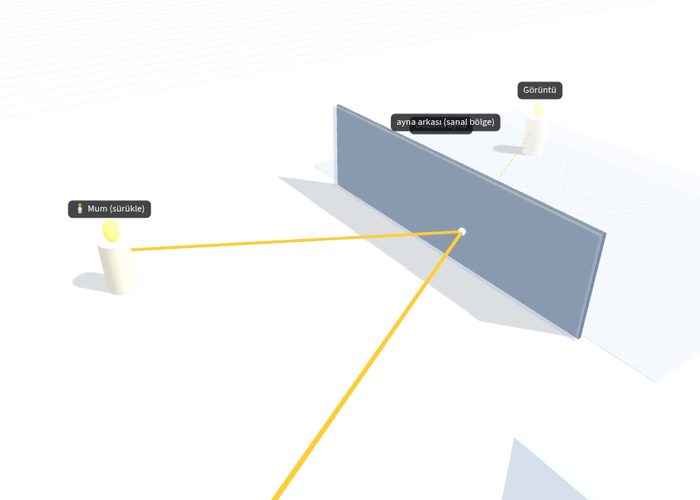 Interactive experiment