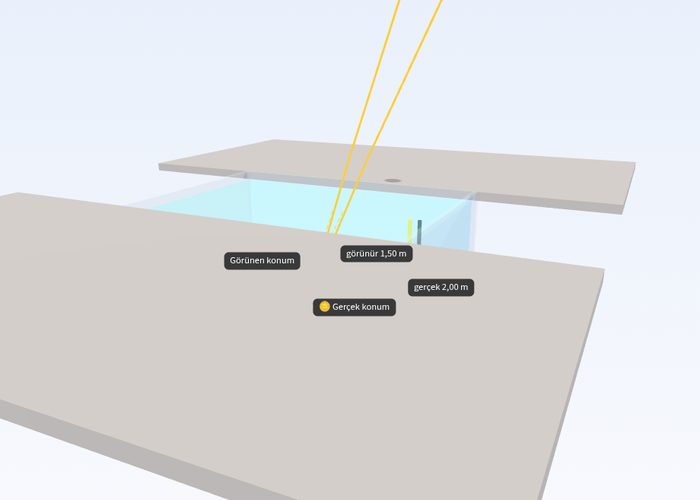
Apparent depth: look at a coin in a pool from above; change the real depth and the liquid, discover through the extension of refracted rays that the coin appears closer and the relation h' = h·n_observer/n_object; the broken appearance of a spoon in water
Discover why objects in water appear closer than they actually are with the apparent depth simulation, one of the most engaging topics in the optics unit. Thanks to this interactive experiment, you can observe the reason why a coin in a pool or a spoon in water appears broken and closer through the laws of refraction of light. By changing different liquid media and real depth values, you can interactively examine the path of rays and learn the physical principles behind optical illusions.
What can you do in this simulation?
You can observe the change in the object's position by changing the real depth value.
You can examine the effect of the medium's refractive index on apparent depth by selecting different liquid types.
You can see why the coin or object is perceived closer by following the extensions of the refracted rays.
You can reinforce your theoretical knowledge with practice by answering the guided questions.
You can test the accuracy of the formula by checking your measurement results.
Basic concepts and formulas
The refraction of light as it passes from a denser medium to a less dense medium (or vice versa) causes objects to appear in different places than they actually are. The apparent depth relation, which applies when the eye is in the less dense medium and the object is in the denser medium, is as follows: h' = h · (n_eye / n_object). Here, h represents the real depth, h' represents the apparent depth, and n_eye and n_object represent the refractive indices of the media where the eye and the object are located, respectively.
How to use?
Open the experiment panel and examine the instructions in the guide.
Set the real depth and liquid parameters according to your preference.
Observe the extensions of the refracted rays and the new position of the object.
Test your predictions by answering the questions and check the results.
Frequently asked questions
Why does apparent depth occur?
The change in direction (refraction) of light as it passes between two media with different refractive indices causes the extensions of the rays reaching the brain to be perceived as coming from a different point.
How does the refractive index of the liquid affect the apparent depth?
As the refractive index of the medium increases, the amount of deviation of light also changes, and the object may appear closer or farther to the observer than it actually is.
Is this formula valid for every angle?
The relation generally provides the highest accuracy for observations made at angles close to the normal (small angles).
 Interactive experiment