Fiber optics: send light at different angles into a fiber with a core-cladding structure; observe its propagation via total internal reflection and its escape from the cladding below the critical angle; the effect of core and cladding refractive indices on the acceptance angle
Interactively explore the movement of light within the core-cladding structure, total internal reflection, and the critical angle with the fiber optics simulation. In this experiment, you will send light into the fiber at different angles and observe transmission and escape conditions. You will easily learn the basic principles of fiber optic technology, which is one of the most important topics of the optics unit.
What can you do in this simulation?
You can send light into the fiber with a core-cladding structure at different angles.
You can watch the rule of total internal reflection and how light escapes from the cladding below the critical angle.
You can examine the effect of core and cladding refractive indices on the acceptance angle.
You can discover the acceptance angle by trying 3 different cladding indices.
You can observe both transmission and escape states simultaneously.
Basic concepts and formulas
Fiber optic cables allow light to be transmitted from one end to the other without loss through the principle of total internal reflection. For light to travel inside the cable, the angle of incidence must be greater than the critical angle. The critical angle and refractive indices are expressed by the following relation: sin(θ_critical) = n_cladding / n_core. The acceptance angle is the maximum entry angle that allows light to undergo total internal reflection after entering the fiber.
How to use?
Start the fiber optic simulation by opening the experiment panel.
Change the entry angle of light into the fiber and follow its path.
Observe how the system responds by selecting different cladding indices.
Check your predictions by examining the acceptance angle and critical angle values.
Frequently asked questions
Why doesn't light escape from a fiber optic cable?
Since light undergoes total internal reflection at the boundary between the core and the cladding, it continues to propagate along the inner surface without escaping the cable.
What is the acceptance angle?
It is the maximum entrance angle that light must have in order to propagate via total internal reflection after entering the fiber core without escaping into the cladding.
How does the refractive index affect fiber optic communication?
The difference between the refractive indices of the core and cladding materials directly determines the critical angle and thus the light transmission efficiency.
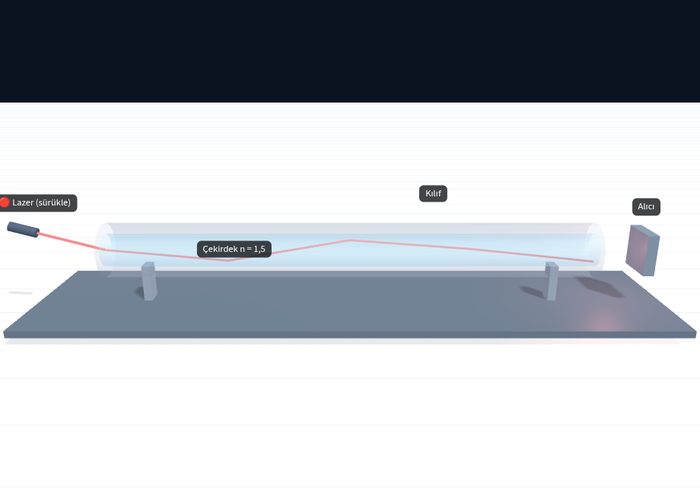 Interactive experiment