Spherical mirrors: change the object distance for concave and convex mirrors; draw the image using special rays, 1/f = 1/d₀ + 1/dᵢ and find the magnification and the location, size, real/virtual, and erect/inverted nature of the image
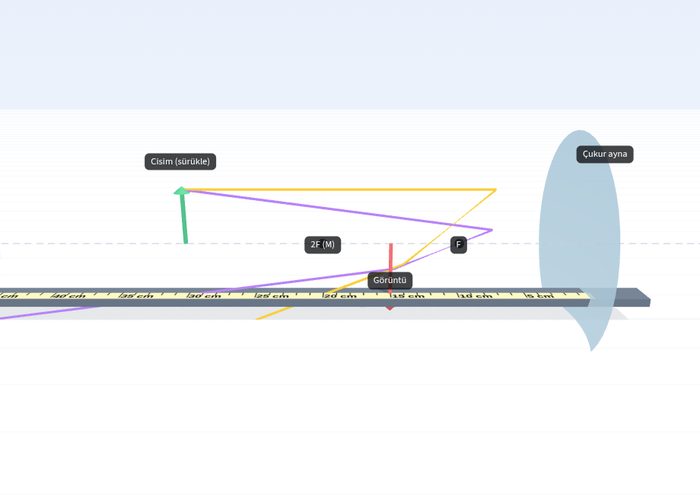
Explore image formation, the relationship between the focal point and the center in concave and convex mirrors interactively with the spherical mirrors simulation. Thanks to this experiment, you will reinforce the optics topics in the 11th grade physics curriculum, and you will test 5 different regions in a concave mirror and the characteristics of a convex mirror with interactive questions.
What can you do in this simulation?
By changing the position of the object in the concave mirror, you can examine the images beyond the center, at the center, between F and 2F, at the focus, and between the focus and the mirror.
You can observe reflections at different positions and the formation of virtual images in a convex mirror.
You can test your theoretical knowledge with practical questions by progressing step by step with the guide.
You can analyze real, inverted, diminished, magnified, or infinite image states.
You can make up for your shortcomings by receiving instant feedback after correct and incorrect answers.
Basic concepts and formulas
The fundamental relationship between the distances of the object and the image to the mirror and the focal length in spherical mirrors is given by the lens and mirror equation: 1/f = 1/d0 + 1/di. Here, f represents the focal length, d0 represents the distance of the object to the mirror, and di represents the distance of the image to the mirror. The magnification formula is defined as m = -di / d0 or as the ratio of image height to object height. While concave mirrors converge light, convex mirrors diverge light and always form upright, virtual, and diminished images.
How to use?
Open the experiment screen and start by reading the instructions in the guide section.
Try the 5 different regions specified for the concave mirror in order and observe the object-image relationships.
Examine the reflection properties by selecting convex mirror positions.
Answer the questions you encounter, and reinforce your knowledge by dragging and dropping the cards into the appropriate boxes.
Examine your correct and incorrect feedback, restart the experiment, and repeat the missing steps.
Frequently asked questions
When is the image real and inverted in a concave mirror?
Unless the object is between the focal point and the mirror (i.e., when it is located in the regions outside the focus), the images formed are real and inverted.
Why does a convex mirror only form a virtual image?
Unlike a concave mirror, since convex mirrors diverge light, the extensions of the reflected rays intersect behind the mirror, which always ensures the formation of an upright, diminished, and virtual image.
Where is the image of an object located at the focal point (F)?
When the object is placed at the focal point of the concave mirror, the reflected rays travel parallel to each other, so the image is formed at infinity.
 Interactive experiment