Refraction: change the angle of incidence as light passes between air, water, glass, and diamond; Snell's law n₁ sin θ₁ = n₂ sin θ₂; critical angle and total internal reflection when passing from a denser to a rarer medium
If you want to examine the path followed by light as it passes through different media and how it changes direction, this light refraction simulation is just for you. You can learn optics rules interactively by observing how light rays behave between different media such as air, water, glass, and diamond. You will discover the mathematical relationship between the angles of incidence and refraction by applying Snell's law.
What can you do in this simulation?
You can experiment with light transitions between air, water, glass, and diamond mediums.
By changing the angle of incidence of the light ray, you can instantly track the path followed by the refracted ray.
You can calculate the critical angle for transitions from a denser to a less dense medium and observe the phenomenon of total internal reflection.
You can reinforce your theoretical knowledge with practice by answering guided questions.
Basic concepts and formulas
The change in speed and direction of light as it passes from one transparent medium to another is called refraction. Given the refractive indices of the media as n1 and n2, the relationship between the angle of incidence θ1 and the angle of refraction θ2 is expressed by Snell's Law: n1·sin θ1 = n2·sin θ2. When light passes from a denser medium to a less dense medium, if the angle of incidence exceeds the critical angle, it is not refracted and undergoes total internal reflection.
How to use?
Open the experiment panel and select air, water, glass, or diamond mediums.
Use the relevant controls to adjust the angle of incidence of the light.
Read the resulting angle of refraction and values from the screen according to the formula n1·sin θ1 = n2·sin θ2.
Test total internal reflection and critical angle conditions by transitioning from glass or water to air.
Frequently asked questions
Why does refraction occur?
Light travels at different speeds in media of different densities. Since the speed of light changes when it changes medium, its direction also undergoes refraction.
When does total internal reflection occur?
When light passes from a denser medium to a less dense medium, if the angle of incidence is greater than the critical angle, the light cannot pass into the other medium and is completely reflected back into the medium it came from.
What does Snell's law express?
Snell's law shows that during the transition of light between media, the ratio of the sine of the angle of incidence to the sine of the angle of refraction is equal to the inverse ratio of the refractive indices of the media.
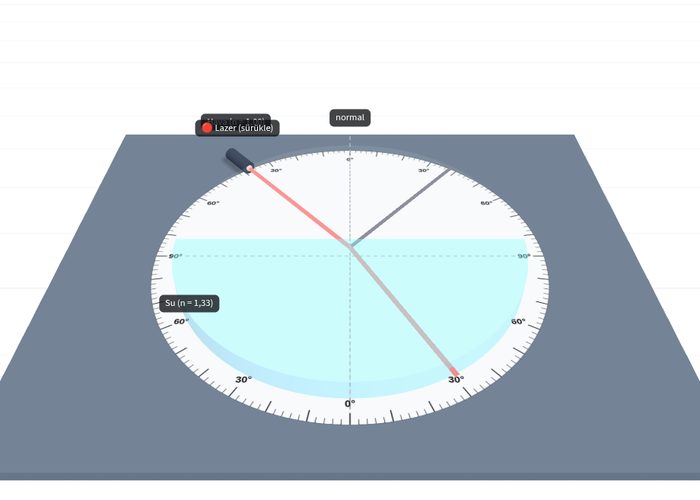 Interactive experiment