Rate law: run experiments by changing concentrations in the 2NO + O₂ → 2NO₂ reaction using the initial rates method; find reaction orders with respect to NO and O₂ and the rate constant k by looking at the table; mechanism and slow step
Explore the mechanism and rate law of the 2NO + O₂ → 2NO₂ reaction using the initial rates method with the chemical reaction rate law simulation. In this interactive experiment, you will observe the changes in reaction rate by altering concentrations and learn how to calculate the orders of substances and the rate constant k. Solving chemistry questions is now much easier with this tool aligned with the high school chemistry curriculum.
What can you do in this simulation?
By applying the initial rates method, you can obtain at least 3 comparable experimental data.
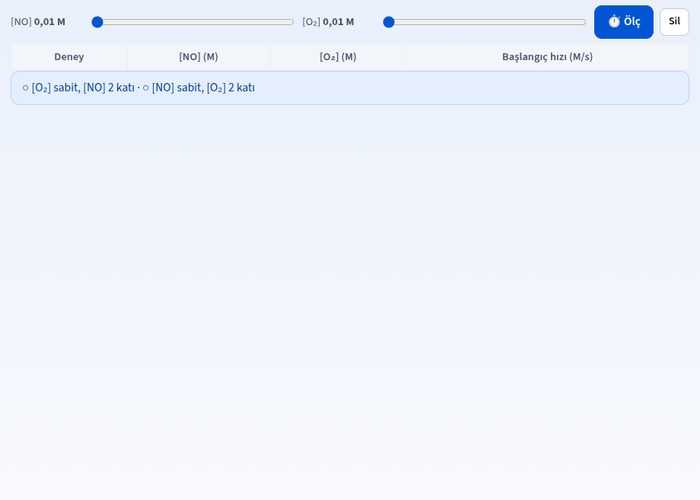
You can change the concentrations of NO and O₂ and observe how the reaction rate is affected.
By examining the ratios in the table, you can place the reaction orders according to the substances into the correct boxes.
You can earn the rate law detective badge by calculating the rate law and the rate constant k value.
You can progress step-by-step with the guide and close your gaps by returning to the questions you missed.
Basic concepts and formulas
The rate of a chemical reaction depends on the concentrations of the reactants. For the 2NO + O₂ → 2NO₂ reaction, the general rate relation is written as Rate = k · [NO]^x · [O₂]^y. Here, k denotes the rate constant, while x and y denote the reaction orders with respect to NO and O₂, respectively. In the initial rates method, orders are clearly found from the rate change ratio by keeping the concentration of one substance constant while changing the other.
How to use?
Go to the experiment panel and examine the initial data and the table.
Perform at least 3 experiments to observe the effect of concentration changes on the rate.
Determine the reaction orders with respect to the substances by comparing the rate ratios.
Match the values you found by dragging and dropping the cards into the relevant boxes.
Complete the test by verifying the rate law and the k constant.
Frequently asked questions
What is the method of initial rates?
It is the method of measuring the rates at the initial moment of the reaction by changing the initial concentrations of the reactants in multiple experiments, and thereby deriving the rate law.
How is the reaction order found?
In the experimental table, while the concentration of one substance is kept constant, the order of that substance is found as an exponential expression by looking at how many times the rate multiplies when the concentration of the other substance is doubled.
Does the unit of the rate constant k change?
Yes, the unit of the rate constant k varies for each reaction depending on the total order of the reaction and the units used (usually moles, liters, seconds).
 Interactive experiment