Collision theory: collide particles A and B in a closed container; monitor effective collision rate by changing temperature and activation energy; conditions of correct orientation and sufficient energy; activated complex
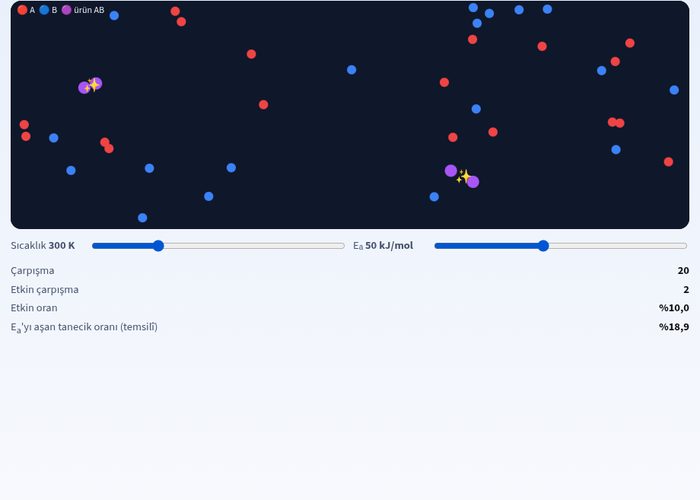
Explore collision theory with the conditions for chemical reactions to occur simulation, and examine the effective collision ratio by colliding particles A and B. In this interactive experiment, you can test critical parameters such as temperature, activation energy, kinetic energy of particles, and appropriate geometric orientation. It is an ideal tool to reinforce theoretical knowledge in chemistry class through practice.
What can you do in this simulation?
You can observe the moments of collision by moving particles A and B in a closed container.
You can test the condition where the kinetic energy of particles is greater than the activation energy.
You can examine the role of the appropriate geometric orientation condition in product formation.
You can follow the formation process of the activated complex during the collision.
You can instantly compare the total number of collisions with the effective collision ratio.
Basic concepts and formulas
For a chemical reaction to occur, it is not enough for particles merely to collide; they must make an "effective collision." There are two basic conditions for an effective collision: Particles must have sufficient kinetic energy (threshold energy / activation energy, Ea) and collide with an appropriate geometric orientation. When these conditions are met, the activated complex, which is a high-energy intermediate state, is formed, and the reaction takes place.
How to use?
Open the experiment screen and examine the initial state of particles A and B in the closed container.
Follow the guide steps and observe the movement directions and energies of the particles.
Record your predictions by answering the questions and prompts.
Check how particles form products (AB) with the correct orientation and sufficient energy.
Examine the collision statistics, restart the simulation, and try different scenarios.
Frequently asked questions
Does every collision result in product formation?
No, not every collision of particles results in products. Only those with sufficient energy and appropriate geometric orientation make an effective collision and turn into products.
What is an activated complex?
An activated complex is the unstable intermediate state with the highest potential energy reached when reactants transform into products.
Why is appropriate geometric orientation important?
It is necessary for the appropriate bonding ends of the particles to face each other so that the collision can break chemical bonds and form new ones.
 Interactive experiment