Theme 1: Interaction
grade 11 chemistry · theme 1
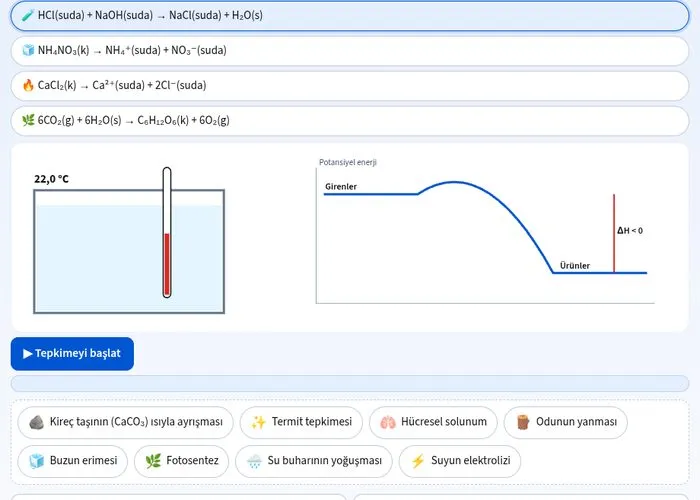
1.1.1 Energy Change Occurring in Reactions
Calorimeter: measure temperature change in neutralization, dissolution of ammonium nitrate, dissolution of calcium chloride, and combustion of methane reactions; compare exothermic and endothermic reactions on an energy diagram; determine the sign of ΔH
Open Simulation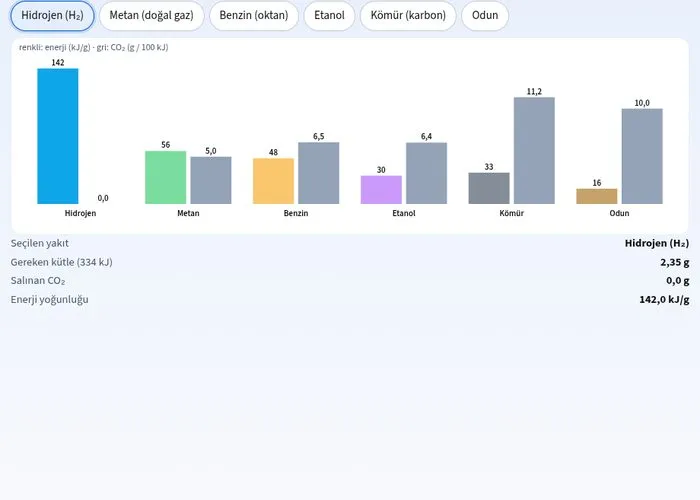
1.1.2 Energy Potential of Substances
Energy potential of fuels: compare energy per gram and CO₂ emission of hydrogen, methane, gasoline, ethanol, coal, and wood; calculate the fuel mass required to boil 1 L of water; energy values of nutrients
Open Simulation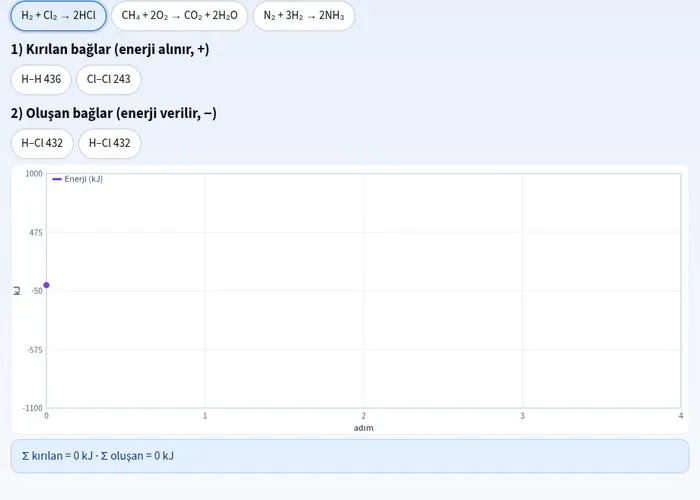
1.1.3 Calculating Reaction Enthalpy Using Bond Energies
ΔH with bond energies: click on broken bonds (absorb energy) and formed bonds (release energy) in H₂ + Cl₂, CH₄ combustion, and ammonia synthesis; calculate ΔH = Σ broken − Σ formed bond energy step by step
Open Simulation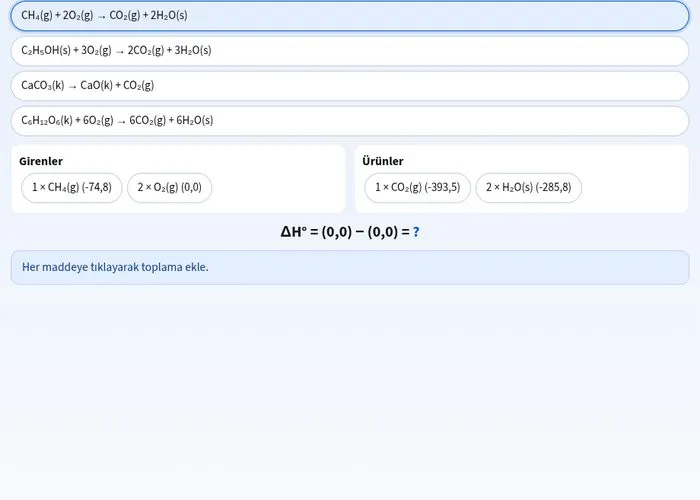
1.1.4 Standard Enthalpy of Formation
Standard enthalpy of formation and Hess's law: calculate reaction enthalpy by selecting products and reactants from the ΔH°f table (ΔH° = ΣΔH°f products − ΣΔH°f reactants); demonstrate that both paths yield the same ΔH in the combustion of carbon to CO₂ via CO
Open Simulation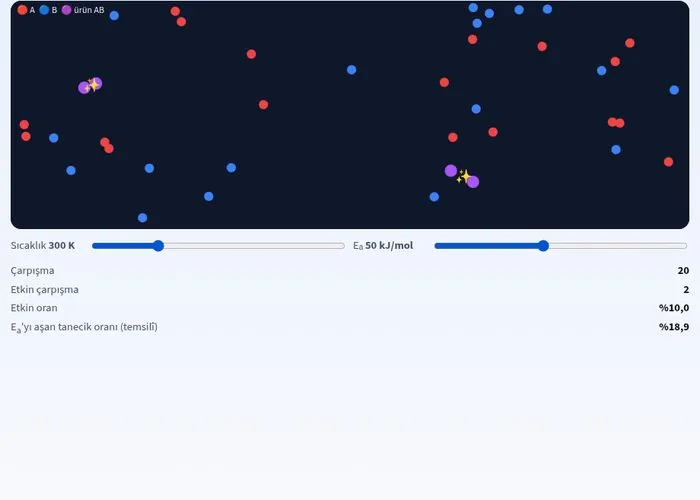
1.2.1 Conditions for Chemical Reactions to Occur
Collision theory: collide particles A and B in a closed container; monitor effective collision rate by changing temperature and activation energy; conditions of correct orientation and sufficient energy; activated complex
Open Simulation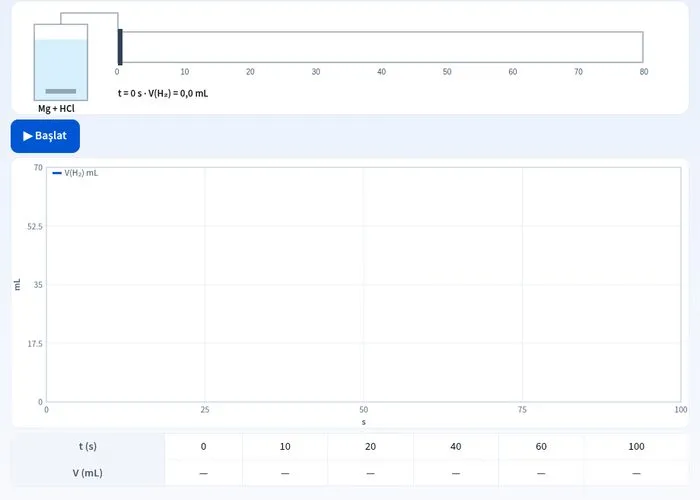
1.2.2 Calculating Average Reaction Rates
Average reaction rate: measure the volume of H₂ collected in a syringe over time in the reaction of magnesium with HCl; calculate the average rate at different time intervals and show on a graph that the rate decreases with time; rate tracking via concentration, volume, and color change
Open Simulation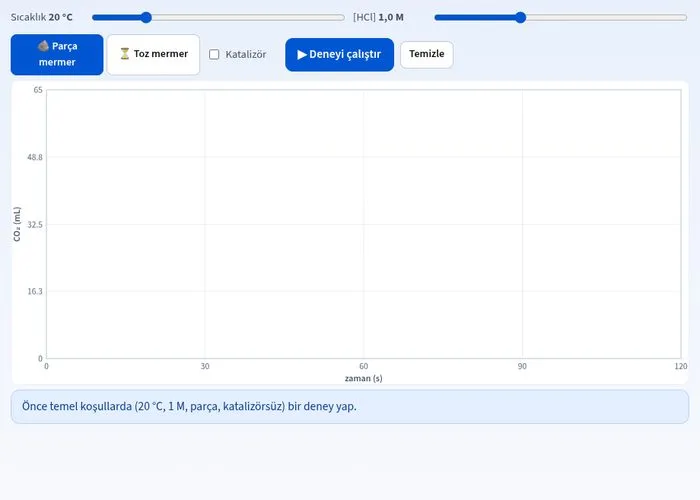
1.2.3 Factors Affecting Reaction Rate
Factors affecting reaction rate: change temperature, acid concentration, marble as powder or pieces, and catalyst in the marble–HCl experiment; compare CO₂ volume–time curves; Eₐ and catalyst effect in Maxwell–Boltzmann distribution
Open Simulation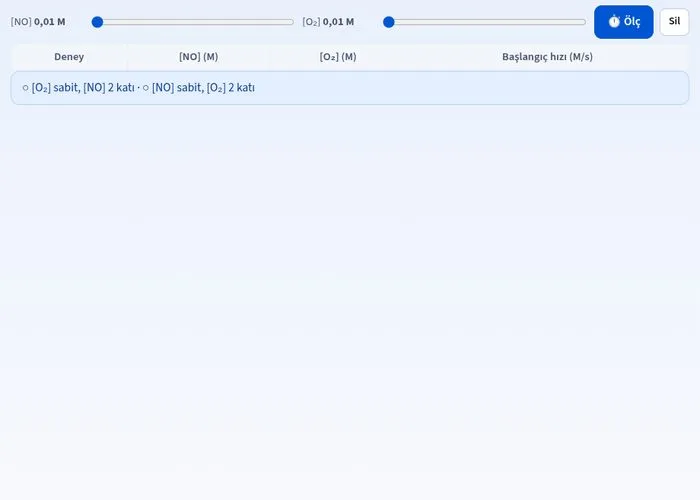
1.2.4 Rate Law of Chemical Reactions
Rate law: run experiments by changing concentrations in the 2NO + O₂ → 2NO₂ reaction using the initial rates method; find reaction orders with respect to NO and O₂ and the rate constant k by looking at the table; mechanism and slow step
Open Simulation