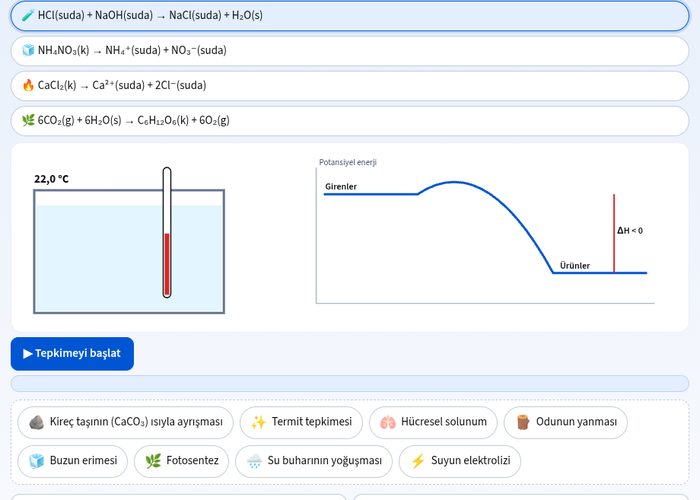
Calorimeter: measure temperature change in neutralization, dissolution of ammonium nitrate, dissolution of calcium chloride, and combustion of methane reactions; compare exothermic and endothermic reactions on an energy diagram; determine the sign of ΔH
Explore heat exchange in chemical reactions with the Energy Change Occurring in Reactions simulation. Using a calorimeter, you will observe temperature changes in neutralization, dissolution, and combustion events. This interactive experiment allows you to distinguish between exothermic and endothermic processes and learn enthalpy change (ΔH).
What can you do in this simulation?
You can measure temperature changes in different reactions with the help of a calorimeter.
You can examine neutralization, dissolution of ammonium nitrate, dissolution of calcium chloride, and combustion events.
You can analyze reactions via potential energy diagrams.
You can compare exothermic and endothermic reactions and determine the sign of ΔH.
Basic concepts and formulas
The amount of heat released or absorbed in chemical reactions is calculated with the formula q = m·c·ΔT. Here, m represents mass, c specific heat, and ΔT temperature change. In exothermic reactions, the system releases heat to the outside and ΔH < 0, whereas in endothermic reactions, the system absorbs heat and ΔH > 0.
How to use?
Select the reaction you want to examine from the experiment panel.
Observe the temperature change by following the calorimeter measurements.
Save your prediction, start the experiment, and check the results.
Complete your classification by placing energy changes and events into the correct boxes.
Frequently asked questions
What does a calorimeter measure?
A calorimeter allows the calculation of the heat of reaction by measuring the temperature change occurring during a reaction.
What is the difference between exothermic and endothermic reactions?
Exothermic reactions release heat to the surroundings and increase the temperature, while endothermic reactions absorb heat from the surroundings and lower the temperature.
Why is the sign of ΔH important?
The sign of enthalpy change (ΔH) directly indicates whether the reaction takes place by releasing heat or absorbing heat.
 Interactive experiment