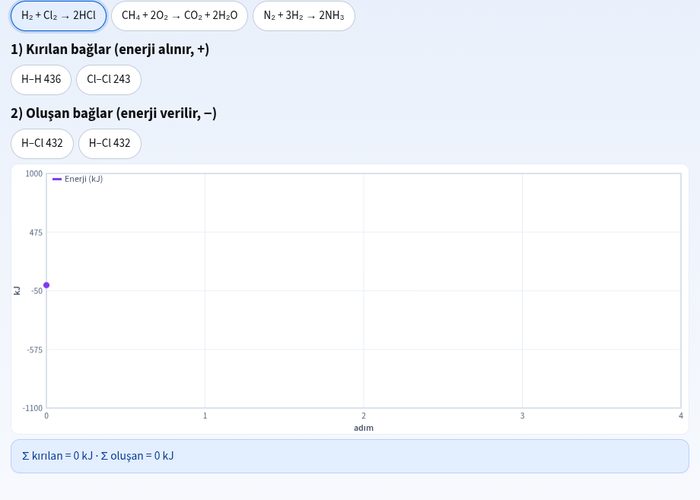
ΔH with bond energies: click on broken bonds (absorb energy) and formed bonds (release energy) in H₂ + Cl₂, CH₄ combustion, and ammonia synthesis; calculate ΔH = Σ broken − Σ formed bond energy step by step
Explore energy changes in chemical reactions interactively with the calculating reaction enthalpy with bond energies simulation. Through fundamental reactions like H₂ + Cl₂, you will learn to calculate the ΔH value step by step by examining broken and formed bonds. This interactive experiment is an excellent tool to reinforce the topic of enthalpy in chemistry class.
What can you do in this simulation?
You can perform bond energy accounting by completing 3 different chemical reactions.
You can observe the energy absorption process by clicking on the broken bonds.
You can examine the energy release step by clicking on the formed bonds.
You can match the steps by dragging and dropping cards into the appropriate boxes or by tapping.
With the help of the guide, you can check your answers and instantly correct your mistakes.
Basic concepts and formulas
In chemical reactions, external energy is required to break the bonds of the reactants (endothermic, ΔH > 0), whereas energy is released to the surroundings during the formation of products (exothermic, ΔH < 0). Net reaction enthalpy (ΔH) is the difference between the sum of the energies of broken bonds and the sum of the energies of formed bonds. Our basic formula is ΔH = Σ(Broken Bond Energies) - Σ(Formed Bond Energies).
How to use?
Open the experiment screen and examine the given reaction, such as H₂ + Cl₂ → 2HCl.
Place the cards and bonds into the relevant boxes by tapping or dragging and dropping.
Complete the calculations for broken and formed bonds and press the check button.
After seeing the correct answers, proceed to other reactions accompanied by the guide.
Frequently asked questions
What is bond energy and why is it always positive?
Bond energy is the energy required to break a covalent bond between two atoms. Since breaking a bond is an endothermic process, bond energies always have positive values.
What does it mean if Delta H comes out negative?
When ΔH (enthalpy change) is negative, it is understood that the reaction is exothermic, meaning it releases heat. The stability of the products is higher than that of the reactants.
Which reactions are examined in this simulation?
In the simulation, bond energy calculations are performed on fundamental reactions such as H₂ + Cl₂, CH₄ combustion, and ammonia synthesis.
 Interactive experiment