Standard enthalpy of formation and Hess's law: calculate reaction enthalpy by selecting products and reactants from the ΔH°f table (ΔH° = ΣΔH°f products − ΣΔH°f reactants); demonstrate that both paths yield the same ΔH in the combustion of carbon to CO₂ via CO
Interactively discover heat changes in chemical reactions with the standard enthalpy of formation simulation. This experiment allows you to perform enthalpy calculations using standard enthalpies of formation and Hess's law, in accordance with the 11th-grade chemistry curriculum. By examining the conversion of carbon to CO₂ via CO, you can test the effect of different pathways on the total enthalpy.
What can you do in this simulation?
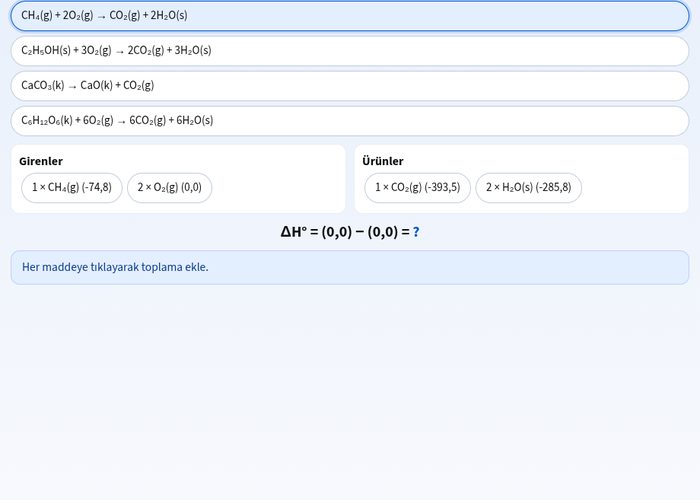
You can calculate the reaction enthalpy by selecting product and reactant substances from the standard enthalpy of formation table.
You can work on different reactions such as CaCO₃(s) → CaO(s) + CO₂(g).
You can observe that the total enthalpy of reactions consisting of multiple steps is the same by using Hess's law.
You can reinforce your theoretical knowledge by answering the questions accompanied by a step-by-step guide.
Basic concepts and formulas
Standard enthalpy of formation (ΔH°f) is the enthalpy change at the moment when 1 mole of a substance forms from its elements under standard conditions (25 °C and 1 atm). The enthalpy change of a chemical reaction (ΔH°) is found by subtracting the sum of the standard enthalpies of formation of the reactants from the sum of the standard enthalpies of formation of the products: ΔH° = ΣΔH°f (products) - ΣΔH°f (reactants). According to Hess's law, if a reaction takes place in several steps, the total enthalpy change is equal to the sum of the enthalpy changes of each step.
How to use?
Open the experiment screen and read the given instructions accompanied by the guide.
Place the cards or substances by dragging and dropping them into the appropriate boxes or by tapping.
Perform your calculations using ΔH°f values and press the check button.
Finish the simulation by completing the reaction steps and examining the results.
Frequently asked questions
What is standard enthalpy of formation?
It is the enthalpy change when a compound forms from its elements under standard conditions, denoted as ΔH°f.
What is Hess's law used for?
It allows us to calculate reaction enthalpy changes that cannot be measured directly by summing the enthalpies of known intermediate step reactions.
What are the enthalpies of formation of elements in enthalpy calculations?
The standard enthalpies of formation of stable elements in their natural states are assumed to be zero.
 Interactive experiment