Energy potential of fuels: compare energy per gram and CO₂ emission of hydrogen, methane, gasoline, ethanol, coal, and wood; calculate the fuel mass required to boil 1 L of water; energy values of nutrients
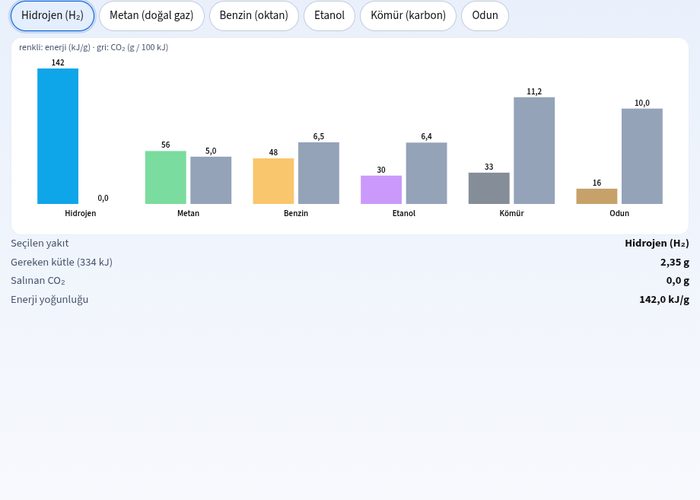
Discover the energy values of fuels and nutrients with the potential of substances to be energy sources simulation. In this interactive experiment, you will compare the energy per gram and CO₂ emissions of fuels such as hydrogen, methane, gasoline, ethanol, coal, and wood, and you will also examine the caloric values of nutrients such as fats, carbohydrates, and proteins.
What can you do in this simulation?
You can examine the energy potentials and the amount of energy per gram of 6 different fuels.
You can compare the CO₂ emission values resulting from the combustion of fuels.
You can calculate the mass of fuel required to boil 1 L of water and observe the results.
You can answer the questions by comparing the energy values of nutrients such as fat (~37 kJ/g), carbohydrate (~17 kJ/g), and protein.
You can make predictions with the step-by-step guide and test your knowledge with experiment results.
Basic concepts and formulas
The energy-yielding capacities of different substances depend on the carbon and hydrogen ratios in their chemical bond structure. For example, hydrogen and hydrocarbons have high energy potential. As for nutrients, fats provide approximately twice as much energy per gram compared to carbohydrates (with Q = m·c·ΔT heat calculations and calorie conversions).
How to use?
Read the guide steps on the energy potential of fuels and record your prediction.
Place the cards and options into the appropriate boxes by dragging and dropping or tapping.
Select fuel types and compare energy and CO₂ emission values.
Answer the questions, press the check button, and examine the correct results.
Repeat the experiment by going back to the steps where you made mistakes or had missing answers.
Frequently asked questions
Why do the energy potentials of fuels differ?
The type and number of bonds in fuel molecules determine the stored chemical energy, which causes different amounts of energy to be released per gram.
Why do fats yield more energy than carbohydrates?
The number of C-H bonds in fat molecules is much higher; the amount of energy released as a result of the combustion of these bonds with oxygen is higher.
Why are CO₂ emissions calculated?
To understand the environmental impact of fuels, the amount of carbon dioxide emitted per unit of energy or per unit of mass consumed is a critical environmental parameter.
 Interactive experiment