Grounding: compare the current passing through a person touching the body of a washing machine with compromised insulation in grounded and ungrounded conditions; residual current device cutting off the circuit at 30 mA
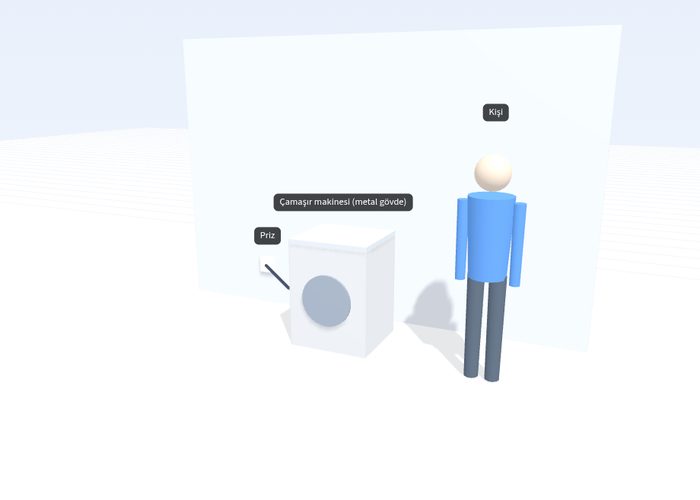
If you want to discover the life-saving fundamentals of electrical safety, this simulation is just for you! You can interactively examine the importance of grounding—one of the most critical topics in the 10th grade physics electricity unit—using a washing machine with compromised insulation. In this experiment, you will observe the effects of electrical leakage on the human body by comparing ungrounded, grounded, and residual-current-device protected scenarios.
What can you do in this simulation?
You can try three different scenarios—ungrounded, grounded, and with a relay—in the compromised insulation washing machine model.
You can observe the amount of current passing through a person and the potential dangers when there is a fault in the appliance casing.
You can test how the residual current device immediately cuts off the circuit when it exceeds the 30 mA threshold.
By answering the questions guided by the instructions, you can reinforce your theoretical knowledge with practice and test your predictions on the simulation.
Basic concepts and formulas
Safety in electrical systems in our homes is ensured by the current following a safe path in case of potential faults. According to Ohm's Law, current intensity is equal to the ratio of voltage to resistance (I = V / R). The human body has a certain resistance, and when the current passing through it reaches milliampere (mA) levels, it poses a life hazard. The earth line protects the person by transferring the leakage current (I) on the appliance casing directly to the earth with near-zero resistance. Meanwhile, the residual current device saves lives by cutting off the circuit within milliseconds when the difference between input and output currents exceeds the 30 mA limit.
How to use?
Go to the experiment panel and select one of the ungrounded, grounded, or relay modes.
Activate the fault condition on the machine and observe the path followed by the leakage current on the casing.
Check the current values (mA) passing through the human body and record the results.
Examine the moment the residual current device cuts off the circuit and repeat different scenarios.
Frequently asked questions
Why does grounding save human lives?
Grounding ensures that any leakage current formed on the metal casing of electrical appliances due to an insulation failure flows safely through the earth line, which has a very low resistance, instead of the human body.
When does the residual current device trip?
The residual current device automatically and very quickly cuts off the circuit when the current imbalance between phase and neutral or the leakage current exceeds the 30 mA limit.
Why is it important to use a grounded socket?
Grounded sockets (Schuko sockets) create an active protective shield against electric shocks by directly connecting the appliance casing to the grounding line.
 Interactive experiment