Electric current: charge flow and I = q/t; same current at every point in a series circuit, sum of branch currents equal to the main branch current in a parallel circuit; measure with ammeters
Interactively explore charge flow and circuit analysis with the electric current simulation. Through this experiment, you will learn how current is distributed in series and parallel circuits, how ammeters are used, and basic current rules.
What can you do in this simulation?
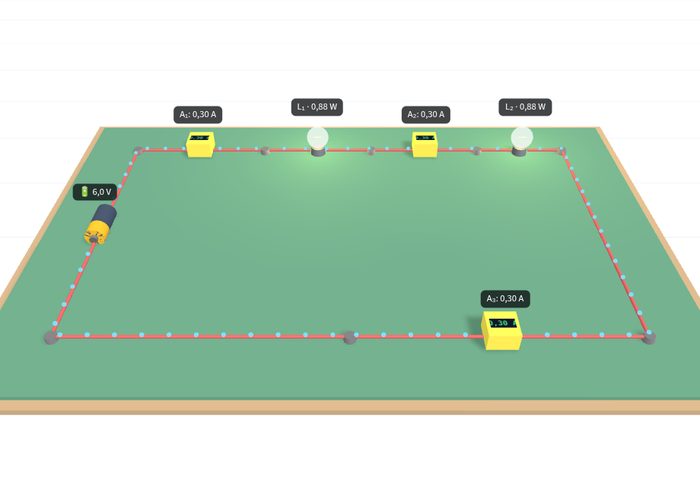
You can observe that the current is the same at every point in a series circuit.
You can test that the sum of the branch currents equals the main branch current in a parallel circuit.
You can measure the current values on the circuit with the help of ammeters.
You can reinforce your knowledge by answering guided questions about charge flow and current intensity.
You can reset the experiment using the restart button and try different scenarios again.
Basic concepts and formulas
Electric current is defined as the amount of charge passing through a unit cross-section in unit time and is expressed by the formula I = q / t. Here, I represents current intensity (Amperes), q represents the amount of charge (Coulombs), and t represents time (seconds). While current passes equally through all resistors in series-connected circuits, the main branch current in parallel branches equals the sum of the currents in the branches.
How to use?
Review the purpose of the experiment and the rules by reading the guide section.
Examine the circuit elements and current values on the experiment panel.
Start the experiment by answering the questions and recording your predictions.
Verify series and parallel circuit rules by tracking ammeter measurements.
Reset the simulation by pressing the Reset button and repeat with different combinations.
Frequently asked questions
Why is the current the same at every point in a series circuit?
In a series circuit, there is only a single path for charges to follow; therefore, the amount of charge passing through any cross-section remains the same everywhere in the circuit.
How is the main branch current found in a parallel circuit?
The main branch current is equal to the algebraic sum of the currents branching into the parallel paths.
How should an ammeter be connected to the circuit?
An ammeter must be connected in series to the circuit in order to measure the current value accurately.
 Interactive experiment