Simple electric circuits: open, closed, and short circuits with a battery, switch, and bulbs; brightness in series and parallel connected bulbs; complete tasks by touching the switches
With the simple electric circuits simulation, you can build your own electrical circuits using a battery, switch, and bulb, and learn the concepts of open, closed, and short circuits. Thanks to this interactive tool, you can observe brightness changes in series and parallel connected bulbs and complete circuit tasks while having fun.
What can you do in this simulation?
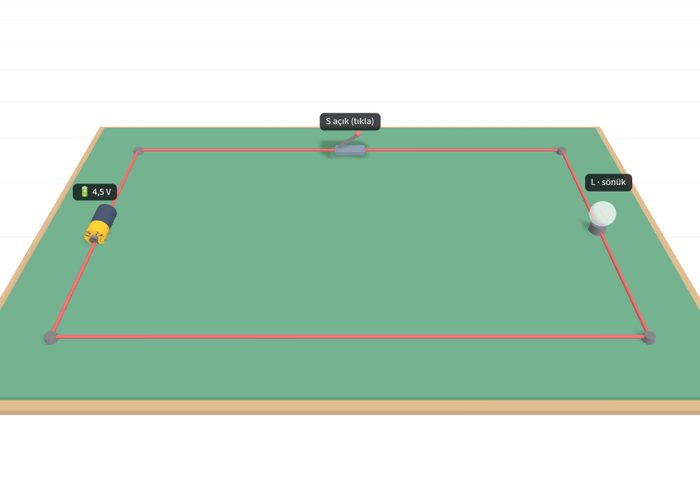
You can set up a single-bulb circuit and turn on the bulb using the switch.
You can test how two bulbs work together by connecting them in series.
You can ensure that only the desired lamp lights up by discovering the parallel connection method.
You can examine short circuit conditions and see the path followed by the current.
You can open and close circuits by touching the switches and successfully complete the tasks.
Basic concepts and formulas
The relationship between current, voltage, and resistance in electrical circuits is explained by Ohm's Law: V = I·R. In series circuits, resistance increases while current decreases, whereas in parallel circuits, each branch receives the same voltage. When the switch is closed, the circuit is completed and current flows; when it is open or a short circuit occurs, the system responds.
How to use?
Select the circuit you want to work on from the simulation screen.
Open or close the circuit by touching the switches.
Place the correct circuit components by reading the task instructions.
Check your predictions and complete the tasks by observing the results.
Frequently asked questions
Why do bulbs connected in series burn dimmer?
In series circuits, as the total resistance increases, the current passing through the circuit decreases, causing the bulbs to shine less brightly.
What is the advantage of bulbs connected in parallel?
Each load receives the same voltage, and even if one of the bulbs blows out or is turned off, the others continue to work.
What is a short circuit?
It is a condition where the current bypasses circuit components by choosing a path of least resistance, which can cause the current to increase excessively.
 Interactive experiment