Ohm's law experiment: change the voltage across a resistor and bulb with an adjustable power supply, measure with an ammeter and voltmeter, plot the V–I graph; slope = resistance; non-ohmic behavior of the bulb
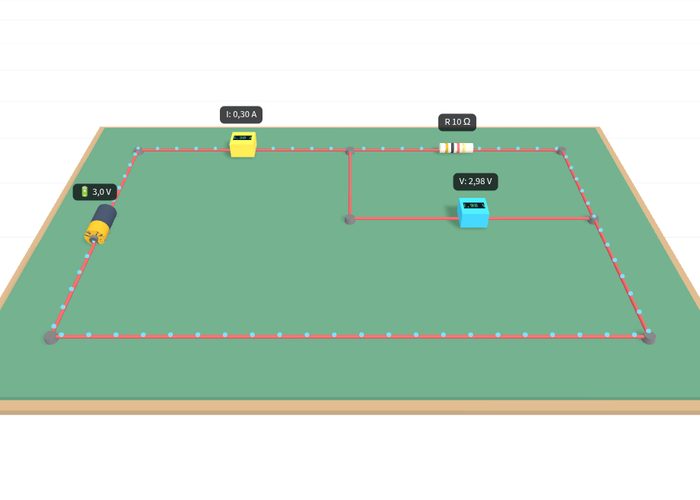
Explore the relationship between current, voltage, and resistance in electrical circuits interactively with the Ohm's law simulation. Change the voltage across the resistor and lightbulb using the adjustable voltage source, and easily generate the V-I graph using ammeter and voltmeter measurements. Through this virtual experiment, you will reinforce your theoretical knowledge in physics by examining the behaviors of ohmic and non-ohmic conductors.
What can you do in this simulation?
You can gradually change the circuit voltage with the help of the adjustable voltage source.
You can instantly measure current and voltage values with the ammeter and voltmeter.
You can draw V-I (voltage-current) graphs with the data you obtain.
You can observe how the graph slope yields the resistance.
You can compare the fixed resistor with the non-ohmic behavior of the lightbulb.
Basic concepts and formulas
Ohm's law states that the ratio of the voltage (V) across the ends of a conductor to the current (I) passing through it yields a constant resistance (R). Our formula is in the form V = I·R. The slope of the line on the graph gives us the resistance value. However, some circuit elements, such as lightbulbs, exhibit non-ohmic behavior because their resistance changes as they heat up.
How to use?
Go to the experiment panel and connect the adjustable voltage source to the circuit.
Change the voltage value and follow the readings on the ammeter and voltmeter.
Record at least 4 measurements for different voltage levels and generate the V-I graphs.
Answer the questions by examining the results you obtained for the lightbulb and the resistor.
Frequently asked questions
What is the formula for Ohm's law?
Ohm's law is expressed by the formula V = I·R, where V represents voltage, I represents current, and R represents resistance.
What does the slope of the V-I graph give?
The slope of the voltage-current (V-I) graph gives the electrical resistance (R) of the circuit element.
Why does a lightbulb exhibit non-ohmic behavior?
As the filament of the lightbulb heats up, its resistance changes, which disrupts the linear relationship between current and voltage.
 Interactive experiment