Connection of generators: connect batteries in series, parallel, and reverse; compare bulb brightness, main branch current, and battery depletion time
With the connection of generators simulation, you can interactively explore the effects on the circuit by connecting batteries in series, parallel, and reverse. In this experiment, you will learn fundamental electrical concepts such as bulb brightness, main branch current, and battery discharge time through practice.
What can you do in this simulation?
- You can observe the voltage increase and bulb brightness by connecting batteries in series.
- You can examine current sharing and how the battery discharge time is extended by making a parallel connection.
- You can test the condition of connecting batteries in reverse to see how the total potential difference is affected.
- You can compare the results of different connection types on the main branch current.
- You can reinforce your theoretical knowledge with practice by answering questions guided by the mentor.
Basic concepts and formulas
In electrical circuits, generators (batteries) supply energy to the circuit. In a series connection, the total electromotive force is equal to the sum of the voltages of the batteries (V_total = V1 + V2 + ...). In a parallel connection, the voltage generated by identical batteries equals the voltage of a single battery, but the system supplies current for a longer time. Ohm's law (V = I·R) is the basis for internal resistance (r) and main branch current (I) calculations.
How to use?
- Open the experiment panel and follow the steps in the guide.
- Place the cards or batteries by dragging and dropping them into the appropriate connection boxes.
- Start the experiment by selecting one of the series, parallel, or reverse connection types.
- Examine the bulb brightness and current values and check your prediction.
- Evaluate the results and repeat different connection scenarios.
Frequently asked questions
What happens when batteries are connected in series?
In a series connection, since the terminals of the batteries are aligned in the same direction, the total voltage of the circuit increases and the bulb glows brighter, but the batteries drain faster.
How does a parallel connection affect battery life?
In a parallel connection, since the current divides into branches, less current is drawn from each battery, which extends the discharge time of the batteries.
What happens to the circuit if batteries are connected in reverse?
Since opposite terminals will oppose each other, the total voltage decreases, and in some cases, the circuit may not work at all or the bulb may not light up.
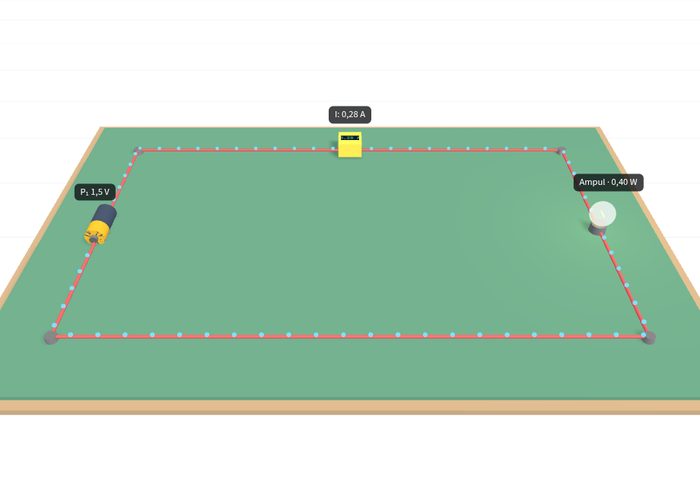 Interactive experiment