The arm is a lever: change elbow angle and the load held in the hand; calculate the antagonistic work of biceps and triceps muscles and the force the muscle must apply; classify joints by their range of motion
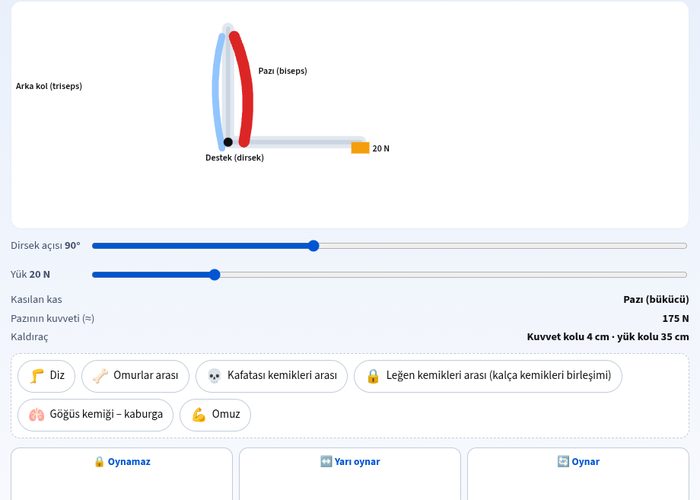
Interactively explore the arm lever mechanism in the human body and the operating principles of joints with the movement-based response simulation. In this experiment, by changing the elbow angle and the load held in the hand, you can see how the biceps and triceps muscles work antagonistically and calculate the force the muscle must apply. It is a great resource for reinforcing musculoskeletal system topics in biology class.
What can you do in this simulation?
You can observe muscle force by changing the elbow angle and the load held in the hand on the arm lever.
You can examine the antagonistic working principle of the biceps and triceps muscles.
You can examine different structures such as the skull, vertebrae, sternum, and pelvic bones.
You can classify joints according to their mobility and place the cards into the correct boxes.
You can answer questions by getting step-by-step hints from the guide panel and track your score.
Basic concepts and formulas
The human arm physically works like a lever system. The elbow joint acts as the fulcrum, muscles act as the force point, and the object held in the hand acts as the load. This system is based on torque balance: Force × Force Arm = Load × Load Arm. The amount of muscle contraction and the force it applies vary depending on the angle of the arm and the magnitude of the load.
How to use?
Open the experiment panel and read the guide texts provided about the arm lever.
Observe the response of the system by adjusting the elbow angle and load.
Place the cards about joints and bones into the correct boxes by tapping or dragging and dropping.
Test your predictions by clicking the check button and examine your results.
Frequently asked questions
How does the arm lever work?
The arm lever allows muscles to move loads by applying force to bones, using the elbow as the joint center (fulcrum).
How are joints classified according to their mobility?
Joints are divided into three types based on their connective tissue structure and mobility: immovable, slightly movable, and freely movable joints.
How do the biceps and triceps muscles work?
These muscles work antagonistically; while one contracts, the other relaxes, thereby allowing the arm to bend or straighten.
 Interactive experiment