Neuron and sensory receptor: change stimulus intensity and see threshold value and all-or-none rule on the action potential graph; effect of myelin sheath on conduction speed; match sense organs with receptor types
Discover neuron, threshold value, and sense organ matching in biology interactively with the sensory receptors and sense organs simulation. In this application, you can examine the action potential graph by changing the stimulus intensity, see the effect of the myelin sheath on conduction velocity, and match various receptors with the correct sense organs.
What can you do in this simulation?
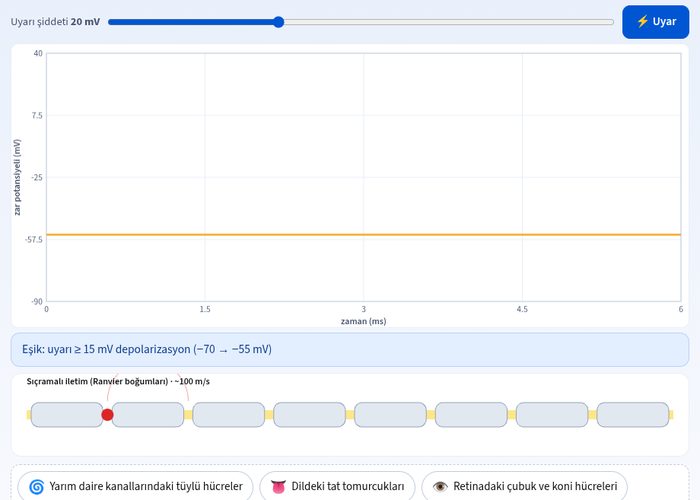
You can change the stimulus intensity and observe the threshold value and changes in the action potential graph.
You can test the all-or-none law by applying different stimulus levels.
You can see the mechanism of saltatory conduction by comparing myelinated and unmyelinated conduction.
You can match structures such as the retina, organ of Corti, semicircular canals, and skin with their corresponding receptor types.
You can track your progress and check your correct answers.
Basic concepts and formulas
The generation and conduction of impulses in nerve cells are based on certain biological rules. For a neuron to generate an action potential, the external stimulus must reach a certain minimum intensity, namely the threshold value. While no response is given to stimuli below the threshold value, the response magnitude remains constant for stimuli at and above the threshold value; this is called the "all-or-none" law. In addition, thanks to the myelin sheath and Nodes of Ranvier, impulse conduction occurs much faster than in unmyelinated neurons (saltatory conduction).
How to use?
Select the stimulus intensity or conduction type from the experiment panel.
Examine the changes in the action potential graph by applying subthreshold and superthreshold stimuli.
Study the comparison of myelinated and unmyelinated conduction to see the speed difference.
Place sensory receptors into the relevant organ boxes by touching or dragging and dropping the cards.
Frequently asked questions
What is the all-or-none law?
It is the rule that a nerve fiber or cell does not respond at all to stimuli below the threshold value, but responds with the exact same intensity to stimuli at and above the threshold value.
How does the myelin sheath affect conduction velocity?
Thanks to saltatory conduction (jumping between Nodes of Ranvier), it accelerates conduction by increasing the impulse conduction velocity to approximately 100 m/s levels.
In which organs are sensory receptors located?
Rod and cone cells in the retina are located in the eye, taste buds in the tongue, olfactory epithelium in the nose, organ of Corti and semicircular canals in the ear, and pressure and temperature receptors in the skin.
 Interactive experiment