Movement in plants: touch the sensitive plant and watch the leaves close via turgor changes; classify movements in response to light, touch, temperature, and chemical stimuli as tropism, nastic movement, and taxis
Explore types of movement in plants interactively through the plant response mechanisms simulation and easily learn the concepts of tropism, nasty, and taxis. Thanks to this educational tool, you can examine biological events you can observe in daily life, such as the closing of a sensitive plant upon touch or the opening of a four o'clock flower. A great interactive experiment awaits you to reinforce plant biology topics.
What can you do in this simulation?
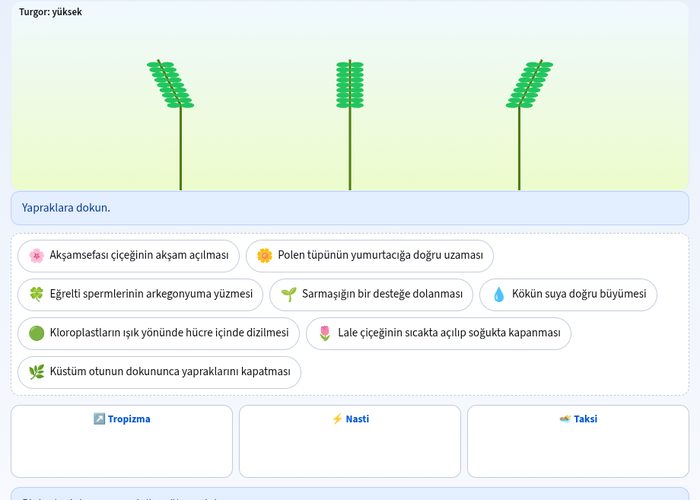
You can observe the closing of the leaves and the change in turgor pressure by touching the sensitive plant.
You can examine the evening opening of the four o'clock flower and the opening and closing of the tulip flower with temperature changes.
You can test directional movements such as ivy twining around a support and roots growing toward water.
You can classify different examples of movement, such as chloroplasts aligning within the cell toward light and fern sperm swimming.
You can test your knowledge with interactive questions by placing 8 different example cards into the correct boxes.
Basic concepts and formulas
Movement mechanisms in plants are basically classified according to whether they depend on the direction of the stimulus. In tropism movements, the direction of the stimulus (such as light or gravity) determines the direction of orientation, and the distribution of the growth hormone auxin is generally effective. In nastic movements, the direction of the stimulus is not important; the movement relies entirely on sudden changes in turgor pressure (the movement of water and K⁺ ions). Taxis movements, on the other hand, appear as the locomotion of the plant or the movement of intracellular organelles.
How to use?
Open the experiment screen to examine examples of movement in plants.
Place the cards and options into the appropriate boxes by tapping or dragging and dropping.
Monitor turgor pressure changes by turning simulation elements such as the sensitive plant on and off.
Test your predictions by answering the questions and get instant feedback.
Frequently asked questions
What is the main difference between tropism and nastic movements?
In tropism movements, the direction of the stimulus determines the direction of movement, and growth is essential. In nastic movements, the direction of the stimulus is not important, and the movement occurs rapidly through changes in turgor pressure.
Why does the sensitive plant close its leaves?
When the sensitive plant is touched, water and potassium ions move out of the cells, turgor pressure drops, and the leaves close rapidly.
Does movement in plants occur only through growth?
No, nastic movements are reversible movements that occur within seconds through changes in turgor pressure and do not require growth.
 Interactive experiment