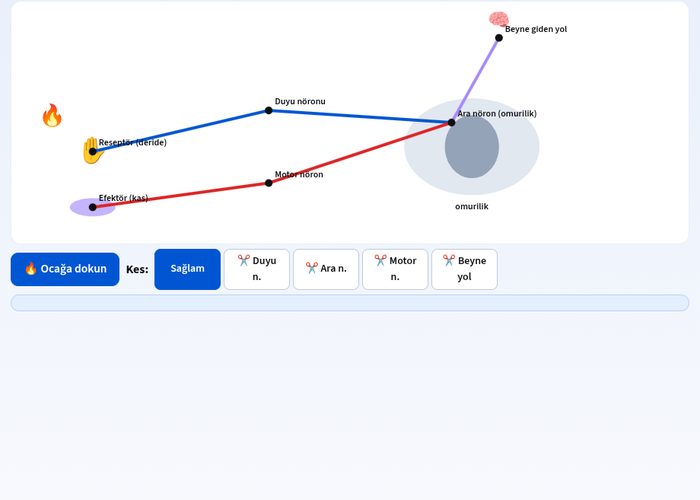
Reflex arc: simulate the pathway of the impulse from receptor to muscle in a hand touching a hot stove; cut the sensory, inter-, or motor neuron or the pathway going to the brain to test what happens to the reflex and sensation
Interactively discover the path followed by an impulse from the receptor to the muscle in a hand touching a hot stove, using the reflex mechanism simulation. In this experiment, you will examine the components of the reflex arc and learn the functions of sensory, relay, and motor neurons. Designed for high school biology classes, this tool helps you understand the difference between voluntary movements and involuntary reflexes.
What can you do in this simulation?
You can follow the path taken by the impulse step by step from the receptor in the skin to the muscle effector at the moment of touching a hot stove.
You can analyze the reflex arc by matching the components of sensory neuron, relay neuron, and motor neuron.
You can test whether the reflex will occur and the state of sensation by cutting the pathway going to the brain.
You can make a comparison between reflexes and voluntary responses by trying different situations such as the knee-jerk reflex, dust getting into the eye, or braking.
Basic concepts and formulas
A reflex arc is the rapid transmission of an impulse taken from a receptor, passing through the central nervous system (spinal cord), to the effector organ (muscle). The pathway follows this sequence: Receptor -> Sensory Neuron -> Relay Neuron -> Motor Neuron -> Effector. In spinal reflexes, a rapid response is generated without the brain getting involved, while the sensation of pain occurs after the response has already taken place.
How to use?
Examine the tested situation by following the guide on the simulation screen.
Place the cards into the relevant boxes or columns by touching or dragging and dropping them.
Change the course of the impulse by cutting or opening neural pathways and test the result.
Verify your answers by clicking the check button and see your shortcomings.
Frequently asked questions
Why doesn't the brain get involved immediately in a reflex arc?
Because saving time during sudden dangers that threaten survival is of vital importance; spinal reflexes generate a direct response without going to the brain to increase signal speed.
What is the difference between a sensory neuron and a motor neuron?
While a sensory neuron carries the impulse from the receptor to the central nervous system, a motor neuron transmits the response received from the central nervous system to effector organs such as muscles or glands.
Why is applying the brakes not a reflex?
Stepping on the brakes is a learned process and a voluntary movement carried out by the decision of the brain, not an involuntary response bound to a reflex arc.
 Interactive experiment