Evolution of the nervous system in animals: nerve net, nerve ladder, ganglionated, and tubular nervous systems from hydra to mammal; compare relative sizes of vertebrate brain regions and relate them to lifestyle
Explore the evolution of the nervous system in living organisms—from hydra to mammals—and the structural changes in vertebrate brain regions with the animal nervous system differences simulation. Through this interactive experiment, you can reinforce your biology knowledge by comparing the nerve net, ladder-like, ganglionated, and tubular nervous systems of different animal groups, as well as their brain volume distributions. It is a great resource for learning about the evolution of the nervous system in animals and the comparison of vertebrate brains interactively.
What can you do in this simulation?
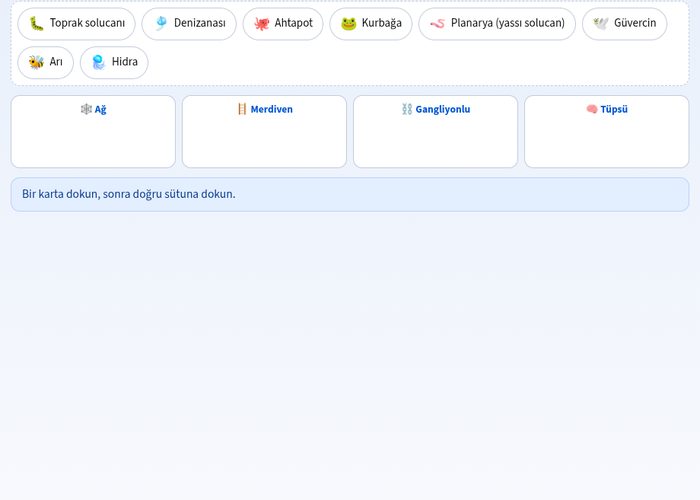
You can correctly categorize different organisms like jellyfish, planaria, earthworms, bees, frogs, and pigeons according to their nervous system types.
You can examine the brains of 5 different vertebrate animals: fish, amphibians, reptiles, birds, and mammals.
You can compare the relative volumes of brain regions such as the forebrain (telencephalon), midbrain (optic lobe), and olfactory lobe.
You can observe the relationship between the lifestyle of organisms and their brain structure.
You can test your predictions with the experiment step by step under guidance and receive instant feedback.
Basic concepts and formulas
The nervous system is the system that enables organisms to receive stimuli from the external environment, evaluate them, and give appropriate responses. In the evolutionary process, invertebrates show a development from simple nerve nets toward centralized ganglion structures. In vertebrates, the tubular nervous system forms the central nervous system (brain and spinal cord). Regions of the brain such as the forebrain, midbrain, and hindbrain have developed in varying proportions depending on the organism's ecological niche and lifestyle (flight, olfaction, temperature regulation).
How to use?
Go to the experiment panel, read the instructions, and start the first step.
Place the given cards or organisms into the relevant boxes or columns by tapping or dragging and dropping.
Verify your answers using the check answers button and benefit from hints if you make a mistake.
During the vertebrate brain comparison stage, examine the relative volumes of the organs and answer the questions.
Repeat the experiment by pressing the restart button and complete all matches without error.
Frequently asked questions
How has the evolution of the nervous system taken place in animals?
The evolution of the nervous system shows a trend toward increasing complexity and centralization, moving from the simplest organisms (such as nerve nets in hydra) to advanced vertebrates (central nervous system and brain).
Which regions of vertebrate brains are compared?
The relative volumes of fundamental brain regions such as the forebrain (telencephalon), midbrain (optic lobe), olfactory lobe, and cerebellum are compared based on the organisms' lifestyles.
Which curriculum topic does this simulation relate to?
This simulation covers the topic of differences in the nervous system among animals, which is included in the 11th Grade Biology course, 1th Theme Response unit.
 Interactive experiment