Stimulus and response: move the light source to watch euglenas swim toward light (phototaxis); classify sea anemone, sundew, bacteria, and dog examples according to stimulus type
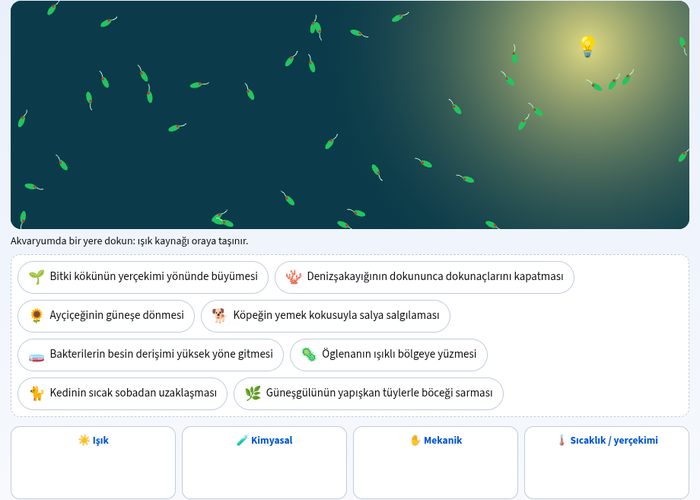
With the simulation of response mechanisms of different living organisms to stimuli, you can examine the phototaxis movement of euglena and discover the responses of organisms to environmental stimuli by moving the light source to different positions. In this interactive experiment, you will reinforce the concept of response—one of the common characteristics of living organisms—through various examples such as euglena, sunflower, sea anemone, sundew plant, bacteria, dog's saliva, and cat. You can make your learning permanent by testing stimulus-response relationships in biology class with fun questions.
What can you do in this simulation?
You can observe euglena swimming toward the illuminated area or escaping from light by changing the light position.
You can move the light to 3 different positions and test the direction of movement of euglena.
You can classify the behaviors shown by different living organisms, such as sea anemones, sundew plants, bacteria, and dogs, according to the type of stimulus.
You can place the cards into the relevant boxes and columns by dragging and dropping or touching them.
You can record your predictions via the experiment panel, instantly check the correct answers, and proceed with the guidance.
Basic concepts and formulas
The exhibition of a specific state by living organisms against physical or chemical changes (stimuli) coming from their external environment is called a response. While these responses are seen in the form of taxism (migration) movements in unicellular organisms, they appear as complex behaviors controlled by the nervous and hormonal systems in advanced organisms. For example, the orientation of euglena towards light with the help of its chloroplasts is an example of positive phototaxis. The orientation of bacteria towards chemical substances is studied as chemotaxis, and the orientation movements of plants as tropism.
How to use?
Open the simulation screen and read the instructions on the experiment panel.
Move the light to different points using the light position settings and observe the movement of the euglena.
Examine the given 8 different organism examples and events, drag and drop them into the appropriate boxes, or place them by touching.
Verify your answers by pressing the Check button and review with guidance if you have any missing points.
Frequently asked questions
How does euglena respond to light?
Euglena shows a positive phototaxis response by swimming toward the illuminated region thanks to its flagellum, and can track the light in 3 different positions as well.
What is taxis and in which organisms is it seen?
Taxis is the locomotion of single-celled organisms with motility depending on the direction of the stimulus; it is frequently observed in euglena and bacteria.
Are stimulus and response common to all living organisms?
Yes, responding to stimuli is one of the common characteristics of all living organisms, but the mechanism of the response varies according to the level of complexity.
 Interactive experiment