Immune timeline: expose the body to an antigen, vaccinate, or give preformed antibodies (serum); compare the antibody concentration graph in primary and secondary immune responses; classify natural and acquired, active and passive immunity
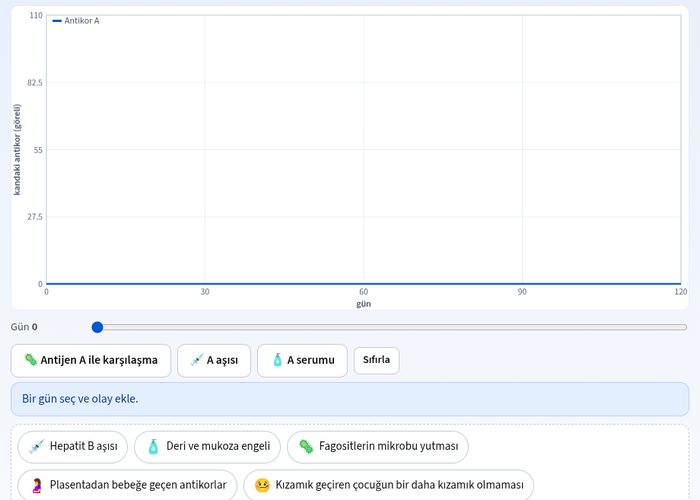
With the immune system simulation, you can interactively examine the body's responses when encountering an antigen, as well as vaccine and serum applications. Thanks to this immune system simulation, you can observe the change in antibody concentration between the primary and secondary immune responses on a graph, and easily learn about active and passive immunity types. This is a great tool to reinforce defense mechanisms in biology class.
What can you do in this simulation?
You can add infection, vaccine, or serum events by selecting a day from the calendar on the immunity timeline.
You can monitor primary and response changes in the antibody concentration graph by administering antigens to the body.
You can try vaccine (active immunity) and serum (ready antibodies, passive immunity) applications separately.
You can classify examples such as contracting measles, Hepatitis B vaccine, breast milk, or snakebite into the correct boxes.
You can test your knowledge with the guide's feedback following correct and incorrect answers.
Basic concepts and formulas
Our bodies develop specific and nonspecific defense mechanisms against microorganisms. While innate immunity starts with physical barriers such as skin and mucous membranes, acquired immunity is divided into active (formation of memory cells through vaccination or contracting a disease) and passive (receiving ready-made antibodies via serum or breast milk). In vaccination, the body produces antibodies and memory cells are formed; in serum, since ready-made antibodies are administered, memory is not formed, and the concentration drops rapidly.
How to use?
Open the timeline screen and select a day from the calendar.
Choose one of the infection, vaccine, or serum scenarios using the add event button.
Observe the changes in the antibody concentration graph and the effects on the timeline.
Tap the example cards given in the classification section and place them in the relevant immunity box.
Complete your shortcomings by following the guide's tips and result messages.
Frequently asked questions
What is the main difference between a vaccine and an antiserum?
A vaccine provides active immunity (memory cell and antibody production) by administering weakened or killed pathogens, whereas an antiserum provides fast but temporary passive immunity by directly administering ready-made antibodies.
Why is the secondary immune response faster and stronger?
Memory cells (B and T lymphocytes) formed during the initial encounter proliferate much faster and produce high amounts of antibodies when re-encountering the same antigen.
How are natural and acquired immunity distinguished?
Natural immunity is innate general defense (skin, phagocytes); acquired immunity develops later in life by recognizing microbes or receiving immune products (vaccine/antiserum).
 Interactive experiment