Pathways of nutrients entering respiration: place the building blocks of carbohydrates, fats and proteins at the entry points in the respiratory pathway; deamination and ammonia; order of energy sources in starvation
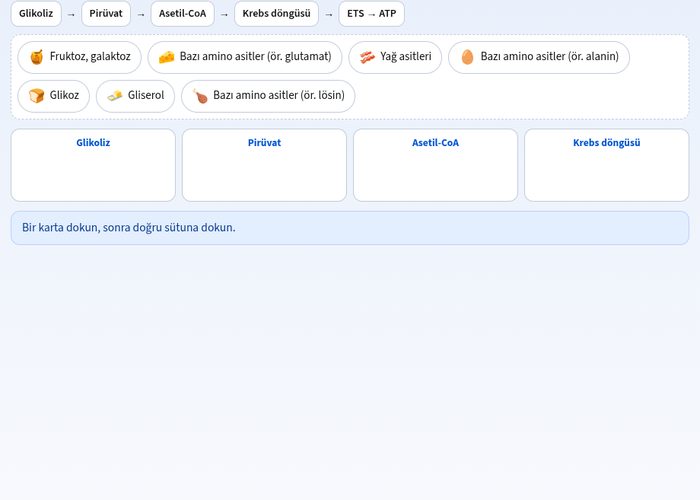
With the nutrient entry points in cellular respiration simulation, you can interactively learn the entry points of the building blocks of carbohydrates, fats, and proteins into the cellular respiration pathway. This experiment allows you to discover how glucose, fatty acids, and amino acids are incorporated into respiration reactions.
What can you do in this simulation?
You can place the building blocks of carbohydrates, fats, and proteins into their correct entry points in the respiration pathway.
You can complete the matching steps by dragging and dropping or tapping the cards.
You can examine the order of energy sources during starvation and metabolic priorities.
You can observe the deamination process and the role of ammonia formation in cellular respiration.
You can reset the simulation using the Start Over button and repeat your selections.
Basic concepts and formulas
Cellular respiration is not limited to glucose alone. Monomers formed as a result of digestion (glucose, fructose, galactose, fatty acids, glycerol, and amino acids) enter respiration reactions at different steps. While carbohydrates generally enter from the glycolysis stage, fatty acids are included in the Krebs cycle via Acetyl CoA. Amino acids, the building blocks of proteins, have their amino group (NH2) removed (deamination) before participating in respiration, and the remaining carbon skeleton attaches to an appropriate step of respiration (pyruvic acid, Acetyl CoA, or Krebs intermediates).
How to use?
Start by reading the instructions on the experiment panel.
Tap or drag the nutrient building block cards on the screen.
Place each building block into the correct entry point in the respiration pathway.
After filling in all the blanks, check your answers and review what you missed.
Frequently asked questions
Why do proteins enter cellular respiration after carbohydrates?
Proteins are primarily used as building materials. They are included in respiration to obtain energy when carbohydrate and fat stores in the body are depleted or in cases of starvation.
What is deamination and why does it occur?
It is the process of removing the amino group containing ammonia (NH3) from the molecule so that amino acids can be used as an energy source in respiration. This allows the remaining carbon skeleton to enter the respiratory cycle.
How do fats enter cellular respiration?
Fats break down into glycerol and fatty acids. Glycerol enters cellular respiration from the glycolysis step, while fatty acids are converted into Acetyl CoA and enter through the Krebs cycle.
 Interactive experiment