Chemosynthesis: hydrothermal vents on the ocean floor where light does not reach; chemosynthetic bacteria obtaining energy from the oxidation of inorganic substances; photosynthesis–chemosynthesis comparison
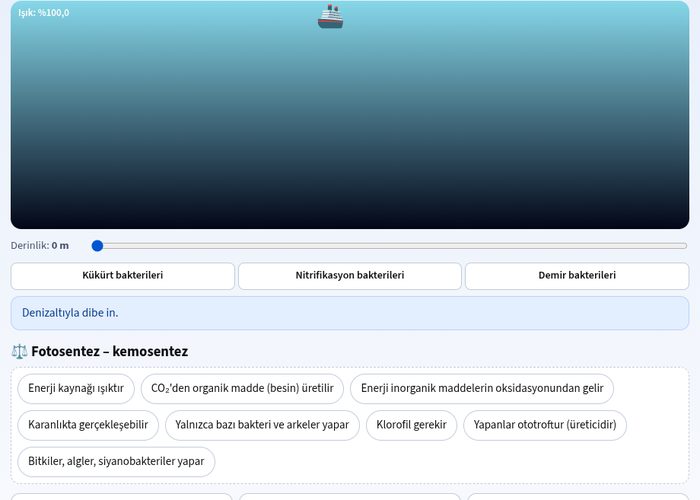
Discover how life exists at depths where sunlight cannot reach with the Nutrient Synthesis Without Using Light Energy (Chemosynthesis) simulation. This interactive experiment allows you to examine step-by-step how chemosynthetic organisms produce their own food by oxidizing inorganic substances. From hydrothermal vents to the functioning of sulfur, iron, and nitrification bacteria, you can learn many biological processes accompanied by interactive questions and guidance.## What can you do in this simulation?- You can descend to the ocean floor with the help of a submarine and observe environments without light.- You can examine sulfur bacteria (H₂S + O₂ → S + H₂O + energy), iron bacteria (Fe²⁺ → Fe³⁺ + energy), and nitrification bacteria.- You can discover the process of converting ammonia to nitrate and its role in the nitrogen cycle.- You can test your predictions through experiments by answering questions guided by a mentor and receive instant feedback.- You can reinforce your knowledge with card matching and sorting activities.## Basic concepts and formulasChemosynthesis is a nutrient synthesis pathway in which the chemical bond energy of inorganic substances is used instead of light energy. Living organisms produce ATP by oxidizing substances such as hydrogen sulfide (H₂S), ammonia (NH₃), or iron (Fe²⁺), and use this energy in carbon dioxide assimilation. For example, in sulfur bacteria, the general equation is H₂S + O₂ → S + H₂O + energy. In the nitrification process, the conversion of NH₃ → NO₂⁻ → NO₃⁻ takes place, providing both energy generation and contributing to the matter cycle in nature.## How to use?1. Open the simulation screen and descend to the ocean floor with the submarine by following the guide's instructions.2. Examine different chemosynthetic bacteria species (sulfur, iron, nitrification) and energy sources.3. Carefully read the questions that appear and record your predictions.4. Complete matching tasks by dragging and dropping or tapping cards into the corresponding boxes.5. Check the correct answers, and reinforce your learning by repeating the steps where you fell short.## Frequently asked questions### Do chemosynthetic organisms need sunlight?No, light energy is not used in the chemosynthesis process; the necessary energy is provided by the oxidation of chemical bonds of inorganic substances. Therefore, it can take place in dark environments such as hydrothermal vents on the ocean floor.### What is the difference between photosynthesis and chemosynthesis?In photosynthesis, light energy is used as an energy source, and water undergoes photolysis to release oxygen. In chemosynthesis, there is no light, energy is obtained from the chemical oxidation of inorganic compounds, and the released oxygen is generally not used or consumed differently in the cycle.### How do nitrification bacteria help plants?Nitrification bacteria contribute to the nitrogen cycle by converting ammonia (NH₃) into nitrite and then into nitrate (NO₃⁻), which plants can use directly, thereby both generating energy for themselves and meeting the nitrogen needs of plants.
 Interactive experiment