Digestive journey in humans: move a bite from the mouth to the large intestine; activate the correct enzyme in each organ; breakdown of carbohydrates, proteins and fats; absorption and transport in villi
Interactively explore the journey of a bite of food from the mouth to the large intestine with the human digestion simulation. Through this experiment, you can easily learn in which organs and how carbohydrates, proteins, and fats are broken down, as well as the role of enzymes and pH conditions in digestion. Reinforce your biology knowledge by solving it right away in your browser.
What can you do in this simulation?
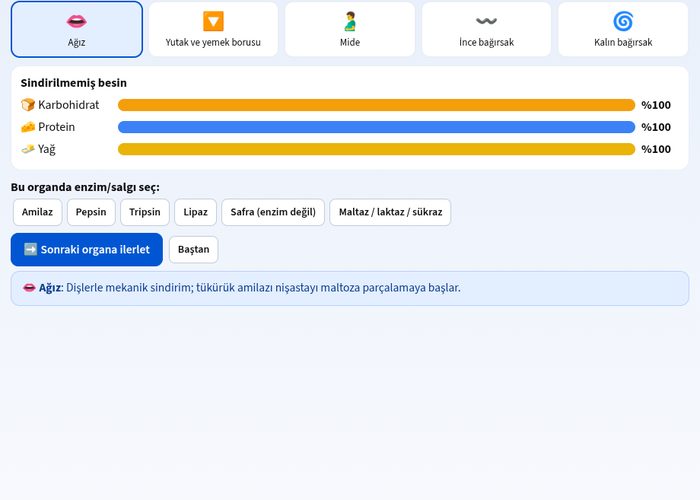
You can advance the bite step by step through the mouth, pharynx and esophagus, small intestine, and large intestine.
You can activate the correct enzyme cards that function in each organ by selecting them.
You can test in which organs carbohydrate, protein, and fat digestion take place.
You can observe the effect of pH changes in different organs such as the stomach and intestines on enzymes.
You can successfully complete your digestive journey by following the scoreboard.
Basic concepts and formulas
Human digestion is the process of breaking down large nutrient molecules through hydrolysis into small building blocks that can be absorbed by villi. Carbohydrate digestion begins in the mouth (salivary amylase), proteins are broken down in the stomach with the help of pepsin and an acidic environment, and in the small intestine, the digestion and absorption of all nutrient groups are completed by pancreatic enzymes (lipase, trypsin).
How to use?
Open the Human Digestion simulation and start the journey from the main screen.
Examine the features of each organ as the food bolus reaches it.
Place the carbohydrate, protein, or fat cards into the appropriate boxes by tapping or dragging.
Test your answer by selecting the enzymes and pressing the "Check" button.
Complete the digestion by progressing with correct steps and return to the guide.
Frequently asked questions
Why doesn't carbohydrate digestion continue in the stomach?
The highly acidic environment (pH) of the stomach disrupts the structure of salivary amylase acting in the mouth, rendering it ineffective.
In which organ and under what condition does the pepsin enzyme work?
Pepsin is secreted in the stomach and is active only in an acidic environment to digest proteins.
Where does the absorption of nutrients take place?
Most of the monomers resulting from digestion are absorbed into the blood and lymph circulation via villi and microvilli in the small intestine.
 Interactive experiment