Cellular respiration: pass a glucose through glycolysis, the Krebs cycle and the electron transport system; location, products and ATP yield of each stage; role of oxygen and anaerobic respiration
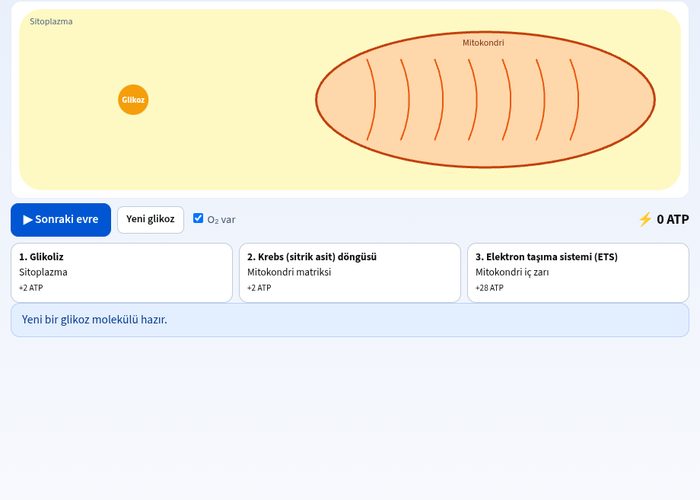
Explore interactively the journey of glucose through the glycolysis, Krebs cycle, and electron transport system (ETS) stages with the cellular respiration simulation. In this experiment, by advancing glucose step by step, you can observe the location, products, ATP yield, and critical role of oxygen for each stage. It is a great resource to reinforce energy production processes in biology class.
What can you do in this simulation?
You can advance glucose through the stages, starting from the cytoplasm all the way to the mitochondria.
You can examine the differences between aerobic and anaerobic respiration by turning oxygen on or off.
You can test your knowledge by dragging and dropping or tapping the cards into the correct boxes.
You can see the amount of energy produced at each stage by tracking the ATP counter.
You can observe the conversion of pyruvate into acetyl-CoA and the release of carbon dioxide.
Basic concepts and formulas
Cellular respiration is an enzyme-controlled process that ensures the breakdown of organic nutrients (glucose) to produce ATP. The general equation for aerobic respiration is C₆H₁₂O₆ + 6O₂ -> 6CO₂ + 6H₂O + ATP. The process consists of three main stages: glycolysis, the Krebs cycle, and the ETS.
How to use?
Open the simulation screen and watch the entry of the glucose molecule into the cytoplasm.
Advance glucose through the glycolysis, Krebs, and ETS stages.
Check the oxygen status and test the "No O₂" option.
Test your knowledge by answering the questions and placing the cards in the appropriate boxes.
Frequently asked questions
Where does cellular respiration take place?
While the glycolysis stage takes place in the cytoplasm, the Krebs cycle and electron transport system (ETS) take place in the mitochondria in eukaryotic cells.
What happens if there is no oxygen?
In the absence of oxygen, the ETS stops, which prevents the Krebs cycle and oxidative phosphorylation; the cell turns to alternative pathways like fermentation to produce energy.
Is ATP consumed during the glycolysis phase?
Yes, a certain amount of ATP is consumed at the beginning of the glycolysis phase to activate glucose, but ATP is still produced as a net gain.
 Interactive experiment