ATP: the energy currency of the cell. Power processes like muscle contraction, active transport, and protein synthesis by breaking down ATP into ADP + Pi; regenerate ATP through respiration and photosynthesis
If you want to discover the importance of energy for life and ATP, the cellular energy unit, this interactive biology simulation is just for you. You will learn by experiencing the structure of the ATP molecule, the mechanism of its conversion with ADP, and how it finances vital tasks within the cell. As you discover how ATP, the energy currency of the cell, is renewed through photosynthesis and respiration, you will also prepare brilliantly for biology exams.
What can you do in this simulation?
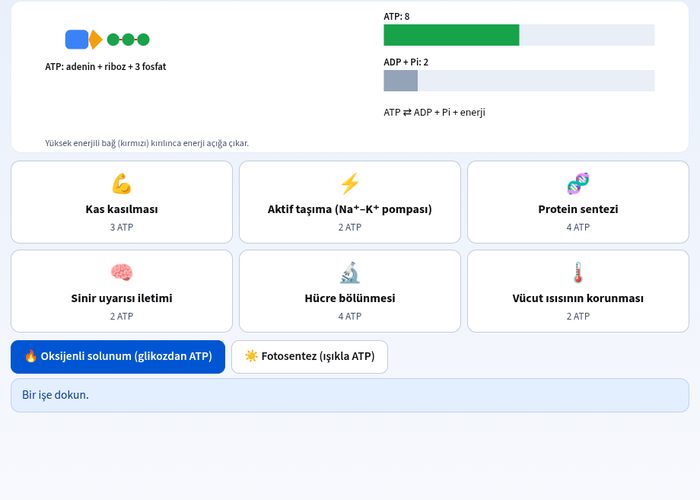
You can examine the structure of the ATP molecule, which consists of adenine, ribose, and three phosphates.
You can observe the energy released by the breaking of high-energy phosphate bonds.
You can power 6 different cellular tasks, such as muscle contraction, protein synthesis, and nerve impulse conduction, with ATP.
You can regenerate depleted ATP using aerobic respiration and photosynthesis processes, keeping the system in balance.
You can test your predictions with experiments by answering guided questions and track your score.
Basic concepts and formulas
All vital activities of living organisms require energy, and this energy is not used directly; instead, it is stored in the Adenosine Triphosphate (ATP) molecule. Energy is released when ATP is converted into ADP and inorganic phosphate (Pi) via hydrolysis. This fundamental balance is as follows: ATP ⇄ ADP + Pi + energy. This reaction is reversible inside the cell; ADP is converted back into ATP through respiration and photosynthesis events.
How to use?
Go to the experiment panel, read the guide's instructions, and examine the information on the cards.
Place the cards on the screen into the relevant boxes or columns by tapping or dragging and dropping them.
Observe energy consumption by running cellular tasks such as muscle contraction and protein synthesis.
Replenish the depleted ATP using aerobic respiration and other production pathways.
Verify your answers by pressing the check button and complete the experiment by repeating the missing steps.
Frequently asked questions
What is ATP and why is it important for the cell?
ATP is the molecule composed of adenine, ribose, and three phosphate groups that provides energy transfer within the cell. It ensures the realization of all vital activities requiring energy, such as muscle contraction, active transport, and protein synthesis.
How does the ATP molecule provide energy?
As a result of one of the high-energy phosphate bonds in the structure of the ATP molecule being broken with the help of water (hydrolysis), a large amount of energy is released and the molecule turns into ADP.
How do cells replenish depleted ATP?
Cells continuously produce new ATP by adding a phosphate group to ADP (phosphorylation) through metabolic pathways such as aerobic respiration, anaerobic respiration, and photosynthesis.
 Interactive experiment