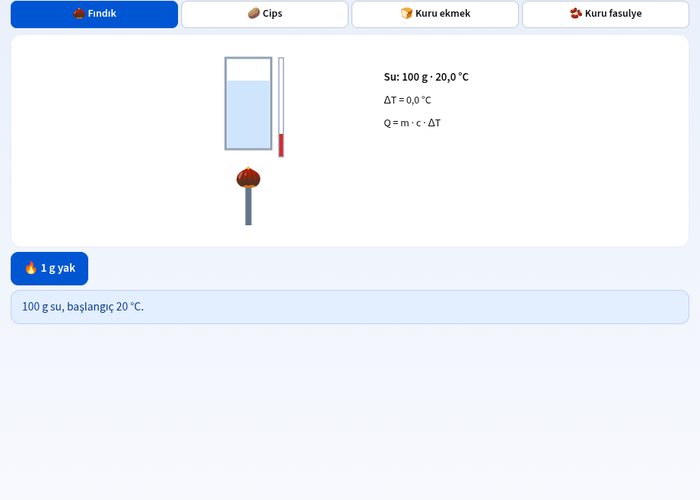
Food calorimeter: heat the water above by burning hazelnuts, chips, bread and dry beans; calculate the energy of 1 grams of food using Q = m·c·ΔT; basal metabolism and daily energy requirement
Interactively discover the calories contained in foods and our body's energy balance with the energy-metabolism relationship simulation. This food calorimeter experiment allows you to observe the temperature change of water by burning foods such as hazelnuts, potato chips, bread, and navy beans, and to calculate the energy of 1 grams of food. Suitable for the 10th-grade biology curriculum, this tool will help you learn about basal metabolism and the factors affecting daily energy needs.
What can you do in this simulation?
You can choose a food among hazelnuts, potato chips, bread, and navy beans and burn it in the calorimeter chamber.
You can observe the temperature increase in the water and the ΔT value while the food burns.
You can calculate the caloric and energy values of foods using the formula Q = m·c·ΔT.
You can compare the calorie difference between four different foods by measuring their energy.
You can examine the effects of conditions such as aging, starvation, and growth periods on basal metabolism.
Basic concepts and formulas
Living organisms use the chemical bond energy in nutrients to sustain their vital activities. A calorimeter chamber is used to find the caloric value of foods in the laboratory. The formula Q = m·c·ΔT is applied to calculate the change in water temperature (where Q represents heat absorbed, m is the mass of water, c is the specific heat of water, and ΔT represents the temperature change).
How to use?
Select the food you want to examine from the experiment panel.
Burn the food and monitor the temperature increase of the water in the calorimeter.
Perform the Q = m·c·ΔT calculation using the obtained values.
Complete the measurements by burning all foods and answer the questions.
Frequently asked questions
Why are nutrients burned in a calorimeter?
It ensures that nutrients are completely oxidized, converting the potential chemical energy they contain into heat and transferring the released heat to water.
What is basal metabolism?
It is the minimum amount of energy expended by a living organism at rest solely for the functioning of vital organs.
What does c represent in the formula Q = m·c·ΔT?
It specifies the specific heat value for water and indicates the amount of heat required to change the temperature of 1 grams of water by 1 degree.
 Interactive experiment