Periodic properties: explore atomic radius, ionization energy, and electronegativity on the periodic table as a heat map and graph against Z; group and period trends, 2A–3A and 5A–6A irregularities
Interactively explore fundamental chemical trends such as atomic radius, 1th ionization energy, and electronegativity with the periodic properties simulation. Thanks to this experiment, you can easily examine the variation trends of elements in the periodic table through heat maps and graphs, and learn about the spherical symmetry irregularities in groups 2A-3A and 5A-6A.
What can you do in this simulation?
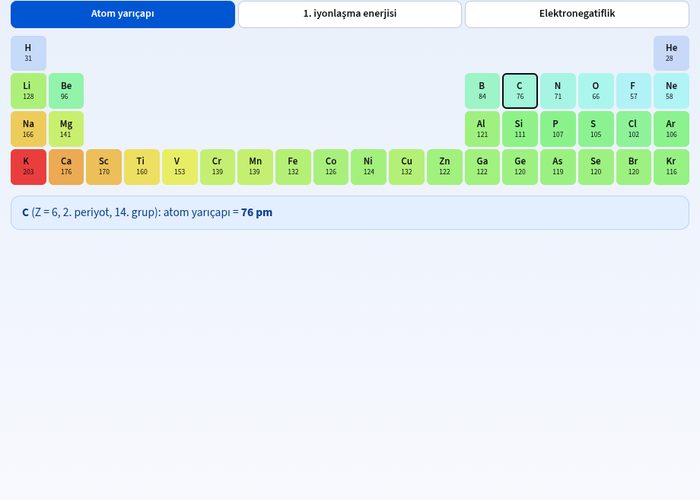
You can observe periodic properties such as atomic radius and ionization energy on a heat map.
You can conduct a detailed examination by selecting at least 6 elements for each property.
You can test the effect of spherical symmetry and stability states on ionization energy.
You can reinforce what you have learned through card matching and prediction steps.
Basic concepts and formulas
As you move from left to right across the periodic table, atomic radius generally decreases, while ionization energy and electronegativity increase. As you move from top to bottom, atomic radius increases while ionization energy decreases. The ionization energy of group 2A is greater than that of 3A, and the ionization energy of group 5A is greater than that of 6A due to spherical symmetry (full/half-filled orbital stability).
How to use?
Select the periodic property you want to examine from the experiment panel (atomic radius, ionization energy).
Examine the values of the elements using the heat map or graph screen.
Answer the questions and record your predictions by following the guide instructions.
Check your correct and incorrect answers and complete your missing knowledge by reading the explanations.
Frequently asked questions
Why doesn't ionization energy always increase from left to right?
Although it generally increases, minor deviations and irregularities are observed between groups 2A and 3A, as well as between 5A and 6A, due to the spherical symmetry rule.
How does atomic radius change across the periodic table?
In the same period, from left to right, the increasing nuclear charge pulls electrons more tightly and the radius decreases; in the same group, the radius increases because the number of shells increases.
What is spherical symmetry?
It is the state of extra stability provided by fully filled or half-filled subshells in orbital diagrams.
 Interactive experiment