Test daily substances with pH paper (lemon salt, vinegar, baking soda, soap, toothpaste, antacid, carbonated drink), how pH changes when water is added; shiny and matte side experiment of aluminum foil
Explore the acidic and basic properties of substances around us with the Chemistry in Daily Life simulation. With the help of pH paper, you can test substances such as lemon salt, vinegar, baking soda, and antacids to reinforce the concepts of acids and bases. Additionally, you can examine the effects of the shiny and matte surfaces of aluminum foil on foods to establish the connection between daily life and chemistry.
What can you do in this simulation?
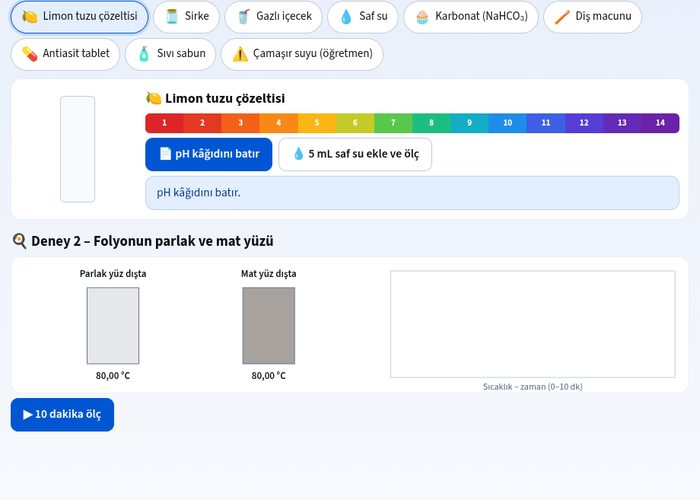
You can perform pH paper tests on 9 different everyday substances and observe whether they are acidic or basic.
You can examine the pH change and the effects of dilution by adding water to substances.
You can run the aluminum foil experiment for 10 minutes to test the effect of shiny and matte surfaces on foods.
By answering questions with the guidance of a mentor, you can test your predictions with experiments and track your success score.
Basic concepts and formulas
In chemistry, the degree of acidity or alkalinity of substances is measured with the pH scale. On this scale between 0 and 14, the point 7 indicates neutrality, while acidity increases toward 0 and basicity increases toward 14. pH is the negative logarithm of the hydrogen ion concentration and is expressed with the formula pH = -log[H+]. Cleaning materials we use in daily life are generally basic, whereas foods are mostly acidic.
How to use?
Select the everyday substance you want to test from the experiment panel and dip the pH paper.
After measuring and recording the initial pH value, observe the change by adding water or classifying the substances.
Proceed to the aluminum foil experiment, choose either the shiny or matte surface, and start the process.
Test your knowledge with the guidance of a mentor by answering the questions at the end of the simulation.
Frequently asked questions
What property do substances with a pH value less than 7 exhibit?
Substances with a pH value less than 7 exhibit acidic properties. These substances generally taste sour and turn blue litmus paper red.
How does adding water affect the pH value of a solution?
As you add water to an acidic solution, acidity decreases and the pH value approaches 7. In a basic solution, adding water decreases basicity, lowering the pH value back toward 7.
Which side of the aluminum foil should face outward?
Experiments and practical observations show that the difference between both sides of the foil coming into contact with food is very small, but proper storage matters depending on the intended use.
 Interactive experiment