Subdisciplines of chemistry: analytical, biochemistry, physical chemistry, organic, inorganic, polymer, and industrial chemistry; place everyday examples into the correct subdiscipline
With the subdisciplines of chemistry simulation, you will discover the daily life application areas of analytical chemistry, biochemistry, physical chemistry, organic, inorganic, polymer, and industrial chemistry branches. This interactive experiment allows you to match many different examples, from determining sugar content to drug synthesis, with the correct chemistry subdiscipline. By reinforcing the fundamental fields of chemistry, you can increase your success rate in science courses.
What can you do in this simulation?
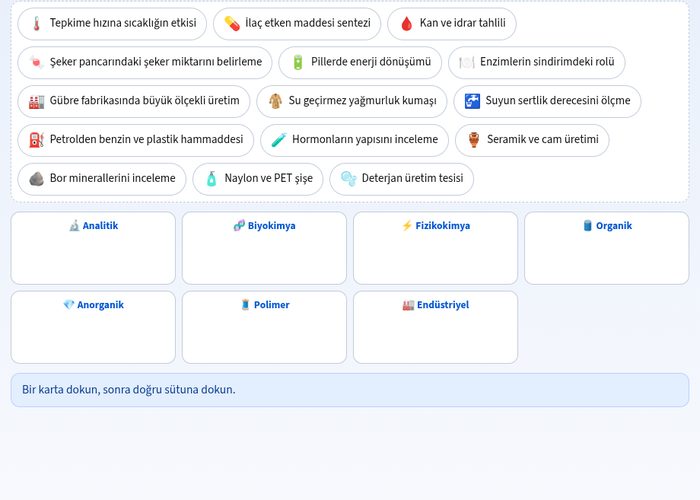
You can examine 15 different examples selected from daily life and industry.
You can place the examples into the relevant chemistry discipline box by tapping or dragging and dropping a card.
You can test your guesses by using the check button and get instant feedback.
You can reset the experiment with the restart button and redo all pairings.
You can follow the question solutions step by step with forward and guide directions.
Basic concepts and formulas
Since the science of chemistry has a wide field of study, it is divided into subdisciplines. While analytical chemistry examines the composition of substances (qualitatively and quantitatively), organic chemistry deals with carbon-based compounds. Biochemistry examines chemical processes in living organisms, and physical chemistry examines physical factors such as reaction rate, energy, and temperature. Inorganic chemistry generally deals with elements other than carbon, polymer chemistry deals with giant molecules (nylon, plastic), and industrial chemistry focuses on the large-scale production of substances in factories.
How to use?
Tap or drag one of the example cards appearing on the screen.
Select the chemistry subdiscipline column or box that you think the card belongs to.
Place all blank spaces and 15 examples into their respective disciplines.
Test the accuracy of your answers by pressing the check button.
If there are incorrect pairings, repeat the experiment by reading the tips from the Guide area.
Frequently asked questions
Why are the subdisciplines of chemistry separated?
Since chemistry is a very broad branch of science, it has been divided into subdisciplines to narrow down its areas of study, facilitate specialization, and examine substances from different aspects (structure, energy, production).
What is the difference between analytical chemistry and physical chemistry?
Analytical chemistry focuses on finding out what a substance is (qualitative) and how much of it there is (quantitative), whereas physical chemistry examines reaction rates, energy changes, and temperature effects.
Which substances does polymer chemistry deal with?
Polymer chemistry deals with giant molecular structures such as nylon, PET bottles, rubber, and plastics, which are formed by the combination of small units called monomers.
 Interactive experiment