Atomic models: compare Rutherford's gold foil experiment with Thomson's and the nuclear model; build atoms, ions, and isotopes by adding protons, neutrons, and electrons
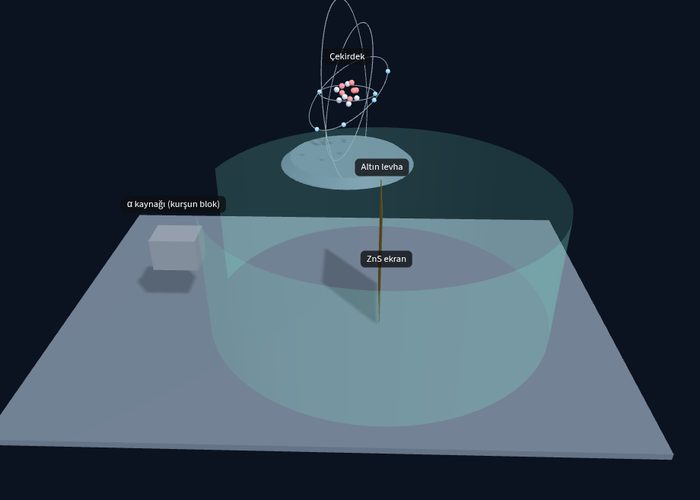
Explore the most fundamental topics of chemistry interactively with the atomic theories and structure of the atom simulation. In this experiment, you will compare Thomson's plum pudding model with Rutherford's gold foil experiment and observe the behavior of alpha rays. With this tool, aligned with the 9th-grade chemistry curriculum, you can reinforce the concepts of atom, ion, and isotope.
What can you do in this simulation?
You can examine alpha ray scattering by comparing the Thomson and Rutherford atomic models.
You can observe particle movements using an alpha source and a ZnS screen.
You can examine aluminum, sulfur, carbon-12, and carbon-14 isotope particles.
You can build atomic models by adding protons, neutrons, and electrons.
You can answer questions guided by a mentor and test your predictions with the experiment.
Basic concepts and formulas
An atom consists of a nucleus (protons and neutrons) and an electron cloud surrounding it. In Rutherford's experiment, most alpha particles (He²⁺) passed straight through while some were deflected at a large angle, indicating that the positive charge is concentrated in a small nucleus. The mass number is calculated with the formula A = Z + N (Z: number of protons, N: number of neutrons).
How to use?
Open the simulation screen and follow the steps in the guide.
Activate the alpha source to watch the rays pass through the foil and compare the two models.
Place the cards and particles into the correct boxes or columns.
Create the target particles and evaluate the results by pressing the check button.
Frequently asked questions
What did the Rutherford gold foil experiment prove?
The experiment proved that most of the atom is empty space and the positive charge is concentrated in a very small nucleus at the center.
What is an isotope atom?
Atoms with the same number of protons but different numbers of neutrons are called isotopes; for example, Carbon-12 and Carbon-14.
By whom was the plum pudding model proposed?
According to this model, proposed by J.J. Thomson, electrons are embedded within a positively charged pudding.
 Interactive experiment