Laboratory safety: recognize GHS hazard pictograms, evaluate laboratory behaviors, safe use of household chemicals (bleach + spirit of salt hazard)
You can interactively learn the rules to watch out for in the laboratory environment, GHS risk pictograms, and the hazards of commonly used household chemicals with the use of chemical substances and safety simulation. This simulation enables you to recognize safety symbols encountered in chemistry classes, adopt correct laboratory behaviors, and comprehend how to take precautions against potential accidents. By testing your knowledge with card matching and scenario-based questions, you can gain proficiency in chemistry laboratory safety.
What can you do in this simulation?
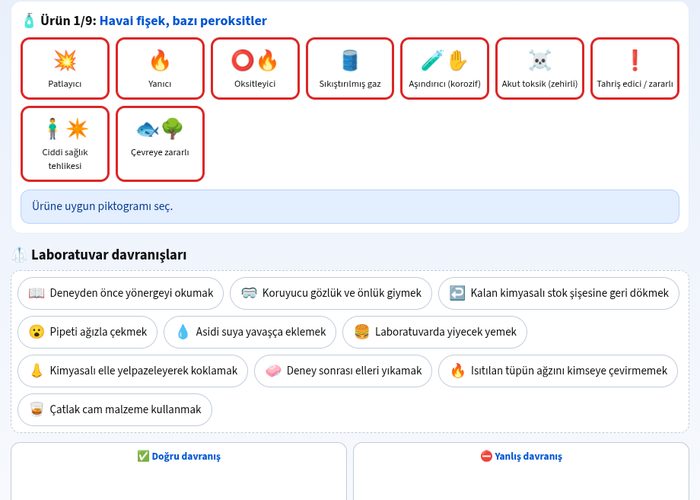
- You can match GHS risk pictograms such as explosive, flammable, corrosive, and toxic with the correct categories using cards.
- You can evaluate the correctness of laboratory behaviors such as adding acid to water slowly or using cracked glassware.
- You can examine the dangerous situations arising from the accidental mixing of household chemicals such as bleach and spirit of salt.
- You can select the correct first aid steps to take in emergencies such as a chemical splash in the eye.
- You can learn correct and incorrect laboratory practices with instant feedback by following the steps accompanied by the guide.
Basic concepts and formulas
Safety in chemistry laboratories is a primary priority to prevent potential accidents. GHS (Globally Harmonized System) pictograms communicate the physical, health, and environmental hazards of substances using universal symbols. For example, corrosive substances harm the skin and metals, while acute toxic substances can lead to poisoning. As a result of mixing bleach (NaOCl) and spirit of salt (HCl), which is one of the frequent mistakes made in home cleaning, toxic chlorine gas (Cl2) is released: NaClO + 2HCl -> NaCl + H2O + Cl2(g)
How to use?
- Read the instructions on the simulation screen and examine the pictogram cards.
- Tap a card and then drag it to the box or column it belongs to in order to complete the matching.
- Answer scenario questions related to laboratory behaviors and household chemicals.
- Press the check predictions button to see your correct and incorrect answers.
- Review the topics you are lacking by reading the explanations and test yourself again using the restart button.
Frequently asked questions
What do GHS pictograms mean?
GHS pictograms are international standard visual symbols indicating the physical, health, and environmental hazards posed by chemical substances.
Why should bleach and spirit of salt not be mixed?
When these two cleaning agents are mixed, they undergo a chemical reaction and release chlorine gas, which is extremely dangerous and toxic for the respiratory tract.
What should be done if a chemical splashes into the eye in the laboratory?
The eye should be washed immediately with plenty of running water or an eyewash station for at least 15 minutes, and the teacher or help should be called instantly.
 Interactive experiment