Theme 1: Interaction
grade 9 chemistry · theme 1
1.1.1 Chemistry in Daily Life
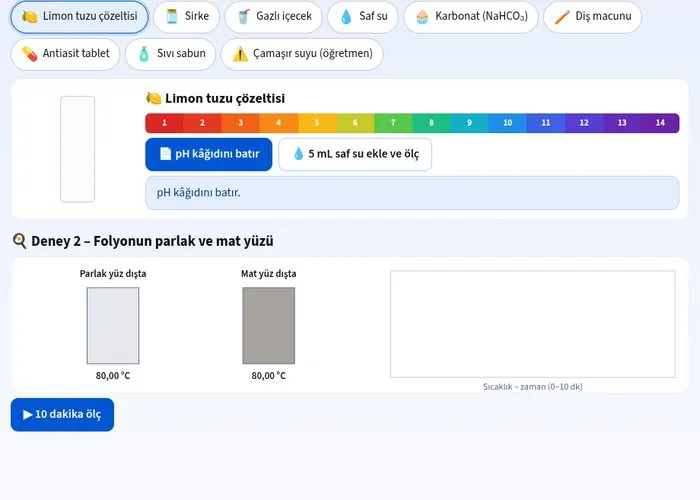
Test daily substances with pH paper (lemon salt, vinegar, baking soda, soap, toothpaste, antacid, carbonated drink), how pH changes when water is added; shiny and matte side experiment of aluminum foil
Open Simulation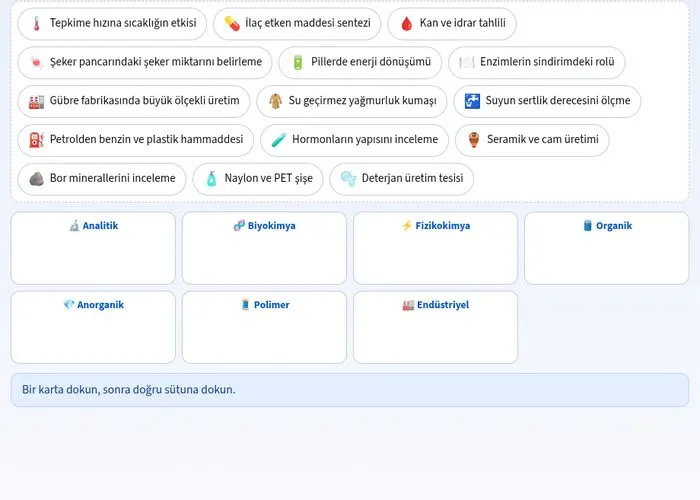
1.1.2 Subdisciplines of Chemistry
Subdisciplines of chemistry: analytical, biochemistry, physical chemistry, organic, inorganic, polymer, and industrial chemistry; place everyday examples into the correct subdiscipline
Open Simulation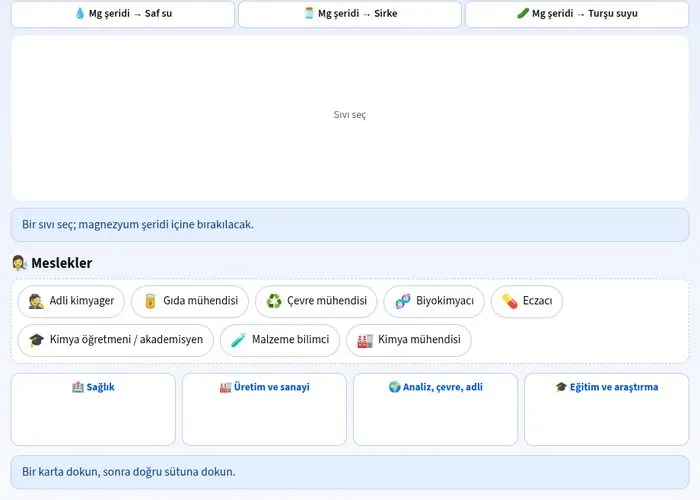
1.1.3 Career Opportunities in Chemistry
Careers in chemistry and pioneers of chemistry: match the professions, examine the pickle experiment in a metal container (magnesium + acid → hydrogen gas), make your own career plan
Open Simulation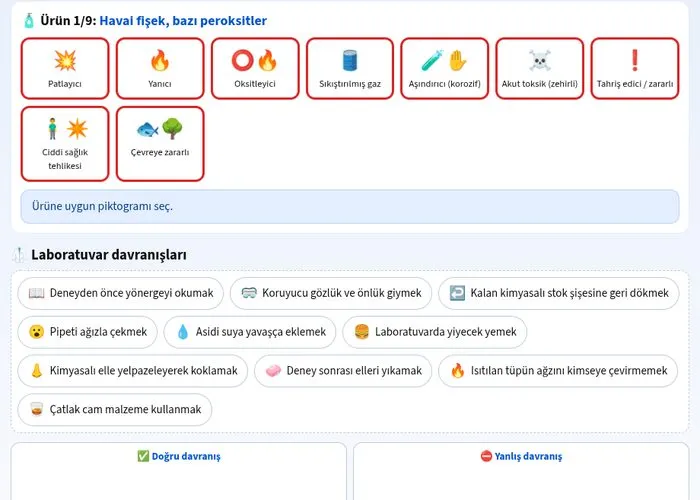
1.1.4 Use of Chemical Substances and Safety
Laboratory safety: recognize GHS hazard pictograms, evaluate laboratory behaviors, safe use of household chemicals (bleach + spirit of salt hazard)
Open Simulation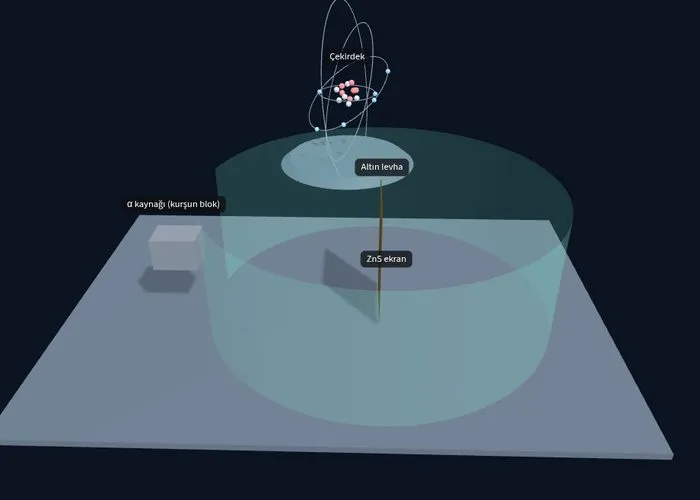
1.2.1 Atomic Theories and Structure of the Atom
Atomic models: compare Rutherford's gold foil experiment with Thomson's and the nuclear model; build atoms, ions, and isotopes by adding protons, neutrons, and electrons
Open Simulation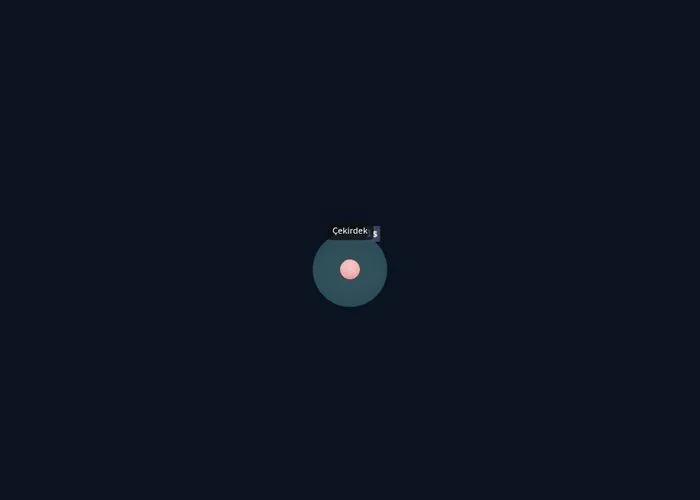
1.2.2 Atomic Orbitals and Electronic Configuration
Orbital box diagram: place electrons starting from 1s; Aufbau, Pauli, and Hund rules are checked instantly; electron configurations of N, O, Na, Cl, Ca, and Fe
Open Simulation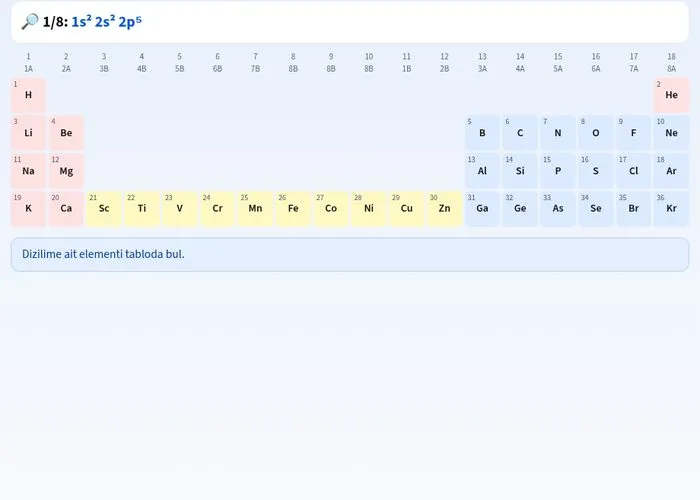
1.2.3 Locating in the Periodic Table
Finding position in the periodic table: find the period and group from the electron configuration, mark the element on the interactive table; s-p-d blocks, ion formation, and isoelectronic species
Open Simulation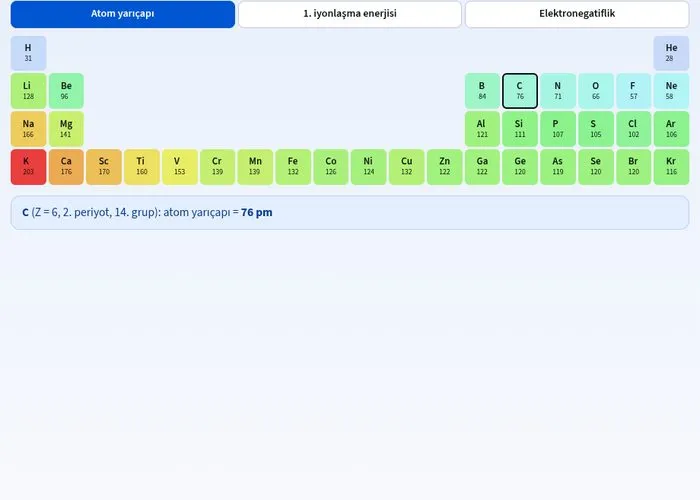
1.2.4 Periodic Properties
Periodic properties: explore atomic radius, ionization energy, and electronegativity on the periodic table as a heat map and graph against Z; group and period trends, 2A–3A and 5A–6A irregularities
Open Simulation