Finding position in the periodic table: find the period and group from the electron configuration, mark the element on the interactive table; s-p-d blocks, ion formation, and isoelectronic species
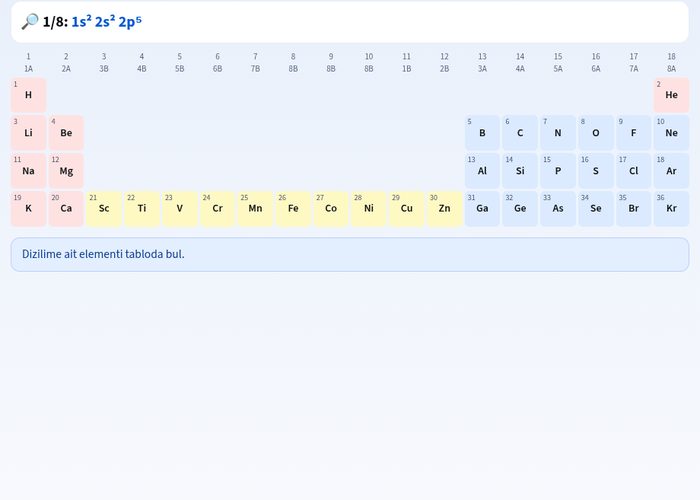
With the finding position in the periodic table simulation, you can easily learn the period, group, and s-p-d blocks based on the electron configurations of elements. This interactive experiment helps you grasp the arrangement of electrons into shells and accurately determine their positions in the periodic system.
What can you do in this simulation?
You can determine the period and group numbers of elements by examining the electron configuration.
You can point out target elements on the interactive periodic table.
You can discover the relationships between ion formation and isoelectronic species.
You can practice the placement logic of elements in s, p, and d blocks step by step.
Following the correct answers, you can close your knowledge gaps with guide feedback.
Basic concepts and formulas
The process of finding a position in the periodic table is based on the atomic number (Z). The electrons of a neutral atom are placed into shells (maximum 2 in the 1th shell, 8 in the 2nd shell, etc.). The number of electrons in the outermost shell gives the group number of the element (for A groups), and the total number of shells gives the period number. For example, a chlorine (Z=17) atom whose electron configuration is 2-8-7 is located in the 3th period and group 7A.
How to use?
Examine the electron distribution or properties of the element asked from the experiment panel.
Determine the period and group information using cards or options.
Mark its position by tapping on the relevant element in the interactive table.
Test your answer by pressing the check button and read the feedback from the Raista mascot.
Repeat the experiment with different elements using the restart button.
Frequently asked questions
How is the period number found from the electron configuration?
The number of shells or energy levels of a neutral atom gives the period number of that element. For example, an element with 3 shells is in the 3st period.
How is the group number determined for A group elements?
The total number of electrons in the outermost shell (valence electron shell) indicates the A group number of the element. For example, if there are 5 electrons in its outermost shell, it is in group 5A.
What do isoelectronic species mean?
Species that have the same number of electrons and electron configurations, but different numbers of protons (nuclear charges), are called isoelectronic.
 Interactive experiment