Resonance and earthquakes: find the natural frequencies of buildings of different heights on a shake table, see the increase in amplitude at resonance; calculate the distance to the earthquake epicenter from the arrival time difference between P and S waves
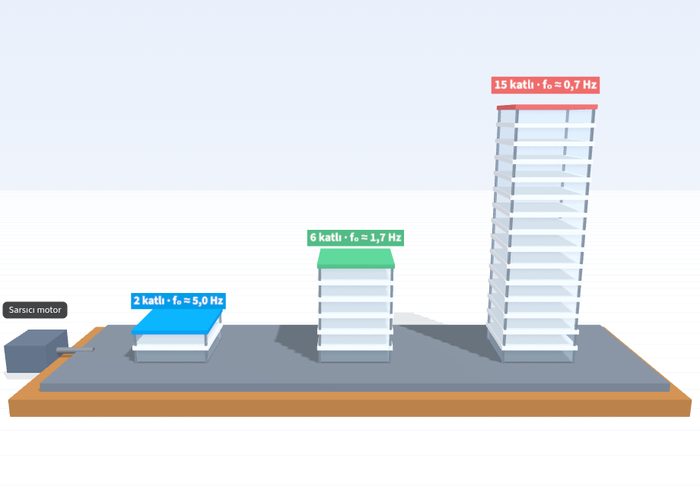
With this resonance and earthquake simulation designed to reinforce the topic of earthquakes and waves, you can examine the behaviors of different buildings on a shake table. By discovering the natural frequencies of 2-story, 6-story, and 15-story buildings, you will observe how the amplitude rapidly grows when the frequency of the driving force reaches the natural frequency of the structure. This interactive experiment enables you to grasp the relationship between wave mechanics and structural resonance most clearly.
What can you do in this simulation?
You can test the resonance frequencies of buildings of different heights with 2 floors, 6 floors, and 15 floors on the shake table.
You can directly observe changes in the oscillation amplitudes of the buildings at different frequency values.
You can match your theoretical knowledge with practice by answering the guided questions.
By resetting the experiment, you can try different scenarios again and analyze the moments of highest amplitude.
Basic concepts and formulas
Resonance is the phenomenon where the oscillation amplitude reaches its maximum value when an external influence (periodic force) with a frequency very close to or equal to its natural frequency is applied to a system. The natural frequency of buildings varies depending on their height and flexibility; short buildings resonate at a higher frequency (e.g., a 2-story building at ~5 Hz), while tall buildings resonate at a lower frequency (~0,7 Hz). You can use the formula T = 1 / f in your calculations for the relationship between frequency and period.
How to use?
Open the simulation screen and examine the building options on the shake table.
Test the frequency values of buildings with different floor heights (2 floors, 6 floors, 15 floors).
Observe the moments when buildings enter resonance and amplitude changes by varying the frequency of the shake table.
Test your predictions and check the results by answering the questions in the guide.
Frequently asked questions
Why does every building have a different resonance frequency?
Since the heights, masses, and flexibility of buildings differ from one another, their structural oscillation characteristics also vary. Short buildings are more rigid and resonate at a higher frequency, whereas tall buildings are more flexible and exhibit resonance at a lower frequency.
What happens to buildings at the moment of resonance?
In the case of resonance, the energy transferred by the external force reaches a maximum level, and the oscillation amplitude of the building increases excessively. When earthquake waves match the natural frequency of the building, the risk of damage can reach its maximum.
Why is this experiment important in earthquake engineering?
The interaction of earthquake waves with ground properties and building heights directly determines structural safety. Engineers increase structural durability by taking possible resonance dangers into account when designing buildings.
 Interactive experiment