Classification of waves: observe transverse (string) and longitudinal (spring) waves side by side; mechanical and electromagnetic waves; classify examples of waves propagating in one, two, and three dimensions
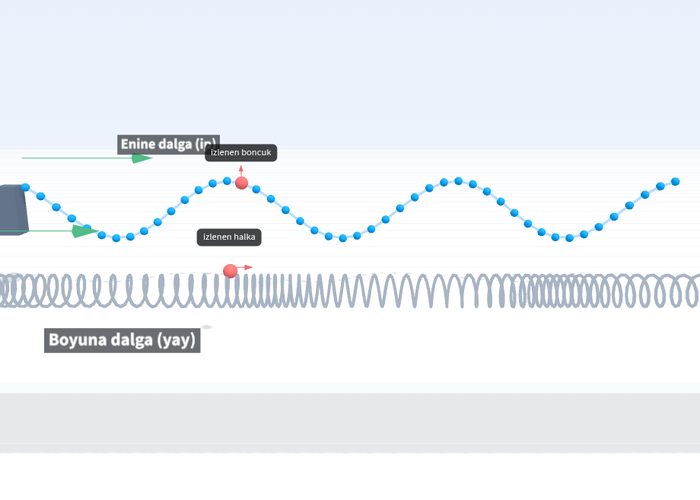
With the classification of waves simulation, you can interactively learn wave types in grade 10 physics, transverse and longitudinal waves, and the properties of mechanical and electromagnetic waves. In this experiment, you will observe rope and spring waves side by side and discover the relationship between the propagation direction and the vibration direction. This is a great interactive practice to reinforce the waves unit in physics.
What can you do in this simulation?
You can examine the relationship between the transverse wave (rope) and the propagation direction.
You can observe compressions and rarefactions on a longitudinal wave (spring).
You can classify examples such as sound waves, guitar strings, compression waves in springs, and earthquake waves.
You can examine electromagnetic wave examples such as light, radio and Wi-Fi waves, and X-rays.
You can test your classification skills by dragging and dropping or tapping cards into the correct boxes.
Basic concepts and formulas
Waves are divided into transverse and longitudinal according to their direction of vibration. In transverse waves, medium particles vibrate perpendicular to the propagation direction, whereas in longitudinal waves they vibrate parallel to the propagation direction. While mechanical waves require a material medium to propagate, electromagnetic waves (light, X-rays, radio waves) can also propagate in a vacuum. Wave speed is expressed by the formula v = f·λ; where v is velocity, f is frequency, and λ is wavelength.
How to use?
Open the experiment screen, read the instructions in the guide, and start examining the wave types.
Carefully watch the transverse wave (rope) and longitudinal wave (spring) animations for at least 5 seconds.
Examine the 9 different wave example cards appearing on the screen.
Place the cards into the corresponding correct column boxes by tapping or dragging and dropping.
Check your answers and complete the experiment by reviewing missing or incorrect parts.
Frequently asked questions
What is the main difference between a transverse wave and a longitudinal wave?
In transverse waves, the direction of particle vibration is perpendicular to the direction of wave propagation. In longitudinal waves, however, particles vibrate in the same direction (parallel) as the propagation direction.
Do electromagnetic waves need a medium to propagate?
No, electromagnetic waves do not require a material medium to propagate; they can also propagate in a vacuum (space) at the speed of light.
Which category do earthquake waves fall into?
Earthquake waves are mechanical waves containing both transverse and longitudinal components. For example, P waves exhibit longitudinal properties, while S waves exhibit transverse properties.
 Interactive experiment