Ripple tank: angle of incidence and angle of reflection in the reflection of linear water waves from an obstacle; decrease in speed and wavelength, constancy of frequency, and refraction when passing from a deep region to a shallow region
You can interactively observe the behavior of linear water waves in a ripple tank using the water wave reflection and refraction simulation. This experiment allows you to discover how waves reflect from obstacles and change their speed, wavelength, and direction as they pass from a deep medium to a shallow medium. You will reinforce wave mechanics topics in physics and make the concepts lasting.
What can you do in this simulation?
You can examine the angle of incoming and reflected waves by changing the angle of the obstacle in reflection mode.
In refraction mode, you can observe how the wavelength decreases by adjusting the depth of the shallow region and the critical angle.
Using the direction and wavelength controls, you can instantly track changes during oblique incidence in the tank.
You can test your theoretical knowledge with practice by answering questions guided step by step.
Basic concepts and formulas
In the reflection of water waves, the angle of incidence is always equal to the angle of reflection. In refraction, however, the frequency (f) of the wave does not change because it depends on the source; nevertheless, the speed (v) and wavelength (λ) change depending on the depth of the medium. The basic wave relation is v = λ·f. As waves pass from a deep medium to a shallow medium, their speed and wavelength decrease while they refract by bending toward the normal. Snell's Law is used to determine the angle of refraction: sin(θ₁) / sin(θ₂) = v₁ / v₂ = λ₁ / λ₂.
How to use?
Start by selecting the Reflection or Refraction mode from the experiment panel.
Change the obstacle angle or shallow region depth using the sliders.
Observe the changes in wavelength and direction values on the screen.
Check the results by answering the questions in the guide and recording your predictions.
Frequently asked questions
Why does the frequency of water waves not change when they pass into a shallow medium?
Frequency depends solely on the characteristic features of the source generating the wave. When the wave moves to a different depth, the frequency remains constant because the source does not change.
How does the wavelength of a wave change as it passes from a deep medium to a shallow medium?
Since the speed of the wave decreases in a shallow medium, according to the formula v = λ·f, the wavelength decreases while the frequency remains constant.
What is the relationship between the angle of reflection and the angle of incidence?
In the reflection of linear water waves from an obstacle, the angle of incidence is equal to the angle of reflection, and this phenomenon is explained by the laws of reflection.
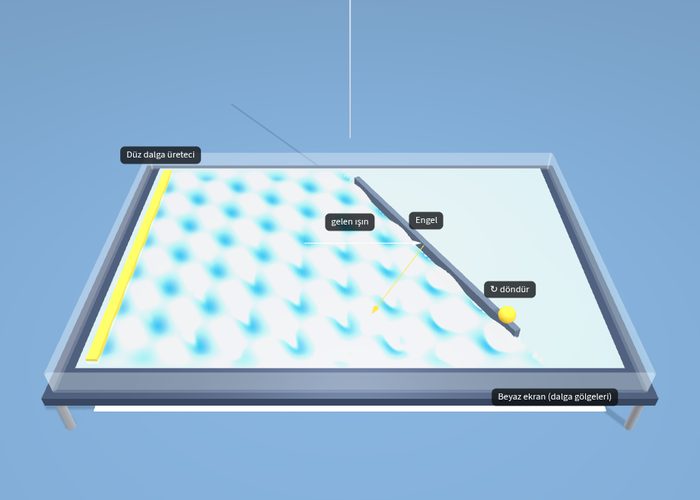 Interactive experiment