Factors affecting wave speed: change the speed of a pulse on a string using tension and mass per unit length, find the relation v = √(F/μ) by measuring; speed of sound in different mediums
With the Factors Affecting the Propagation Speed of Waves simulation, you can interactively examine the speed of a pulse on a string and the propagation characteristics of sound in different media. In this experiment, while testing the effect of the string's tension force and mass per unit length on wave speed, you will discover physical relations through interactive measurements. With this tool, suitable for the high school physics curriculum, you can easily learn the propagation speed of waves from both theoretical and practical perspectives.
What can you do in this simulation?
You can perform experiments with different mass per unit length values using thin string, medium string, and thick string options.
You can observe the direct effect of changing the tension force in the string on the wave speed.
In the measure-and-find mode, you can collect data with at least 3 different tension forces and 2 different string types.
You can compare the propagation speeds of sound in different media such as air and steel, and reinforce theoretical knowledge with practice.
Basic concepts and formulas
The propagation speed of transverse or longitudinal waves traveling along a spring or string depends on the properties of the medium. The speed of a wave on a string varies depending on the applied tension force and the mass per unit length of the string. Our basic formula is v = √(F/μ). Here, v represents the wave speed (m/s), F the tension force in the string (N), and μ the mass per unit length (kg/m). Sound waves travel much faster in solids than in gases; for example, while sound travels at about 5900 m/s in steel, it is around 343 m/s in air.
How to use?
Open the simulation screen, follow the guide steps, and examine the pulse properties on the string.
Determine the mass per unit length by selecting thin, medium, or thick string as the string type.
Observe the speed changes in the wave's motion by changing the tension force values.
Test your predictions about wave speed by completing the measurement steps and answering the questions.
Frequently asked questions
How does the wave speed change if the tension force in the string increases?
According to the formula, as the tension force (F) increases, the propagation speed (v) of the wave also increases.
How does mass per unit length affect wave speed?
As the thickness of the string, which is the mass per unit length (μ), increases, the propagation speed of the wave decreases inversely.
Why does sound travel faster in metals than in air?
Since the space between particles in solid materials is much less than in air, vibrations and sound waves are transmitted much faster.
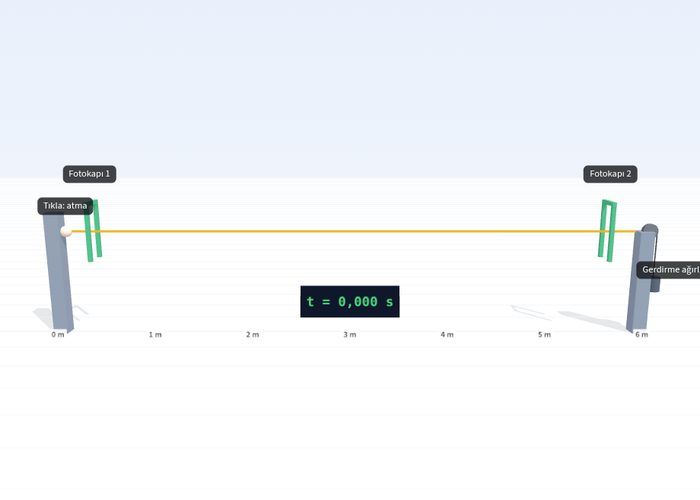 Interactive experiment