Basic concepts of waves: create a wave on a string, change frequency and amplitude; measure wavelength with a ruler, count period, verify the relation v = λ·f; crest, trough, amplitude
Explore the relationships between wavelength, frequency, amplitude, and speed by creating waves on a string with the basic concepts of waves simulation. In this interactive experiment, you can adjust frequency and amplitude, measure wavelength with the help of a ruler, and practice basic wave equations. It is a great digital tool to reinforce the waves unit in physics class.
What can you do in this simulation?
You can observe wave motion on a string by changing the frequency and amplitude.
You can precisely measure the distance between two crests, which is the wavelength, by dragging the ends of the ruler.
You can verify the relation v = lambda f by counting the period and performing calculations.
You can test your theoretical knowledge with practice through guided questions and measurement steps.
Basic concepts and formulas
Waves are forms of energy transfer that propagate through an elastic medium. Wavelength (lambda) is the distance between two successive crests or troughs. Frequency (f) is the number of waves per second. The speed of a wave (v) is equal to the product of its wavelength and frequency, and its formula is v = lambda f. Amplitude is the maximum displacement of the wave from its equilibrium position and is directly related to the energy it carries.
How to use?
Open the simulation screen and start by reading the instructions in the guide panel.
Generate different waves on the string by changing the frequency and amplitude settings.
Measure the wavelength by dragging the ruler tool between two crests.
Record your measurement results and check the v = lambda f relation.
Frequently asked questions
Does amplitude affect wave speed?
Amplitude is related to the energy carried by the wave, but in an ideal elastic medium, it does not directly change the propagation speed of the wave. Speed depends on the properties of the medium.
How does wavelength change if frequency increases?
In a wave propagating in the same medium, if the frequency increases, the wavelength decreases inversely because the speed is constant.
What does the formula v = lambda f mean?
This formula states that the propagation speed of a wave is equal to the product of its wavelength and frequency.
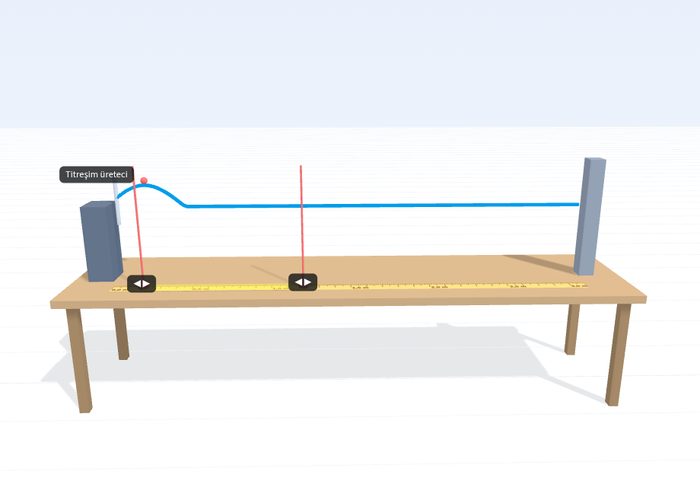 Interactive experiment