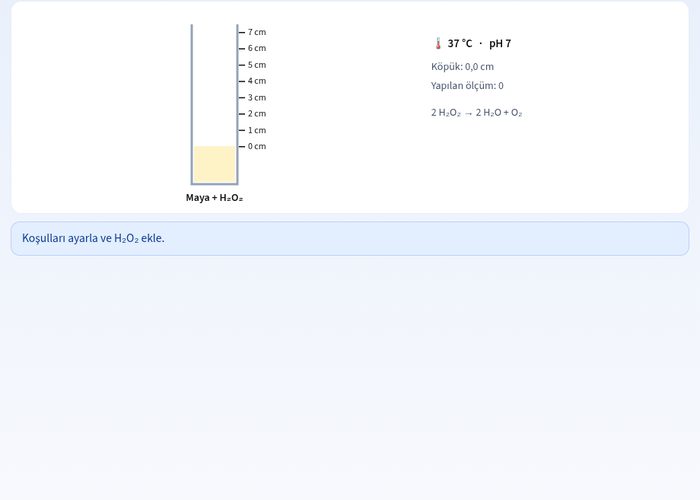
Catalase experiment: yeast + hydrogen peroxide → foam (O₂). Change temperature and pH, measure foam height, plot the enzyme activity graph; control with boiled yeast
Discover the catalase experiment in biology classes in a digital environment with the effect of pH and temperature on enzyme activity simulation! Using yeast and hydrogen peroxide (H₂O₂), you can measure the effect of different temperature and pH conditions on the enzyme rate, and observe the foam height produced by the released oxygen gas. You can reinforce the concept of denaturation with the boiled yeast control group and improve your graph interpretation skills.
What can you do in this simulation?
You can make a control group comparison by preparing test tubes with normal yeast and boiled yeast.
You can change temperature values and examine the relationship between body enzymes and optimum temperature.
You can adjust pH levels to observe the effect of different environments (for example, stomach enzyme pepsin conditions) on catalase activity.
You can test dependent, independent, and controlled variables by keeping the amounts of H₂O₂ and yeast constant.
You can plot the enzyme activity graph by measuring the resulting foam height and interpret the results.
Basic concepts and formulas
Enzymes are protein-based biocatalysts that accelerate biological reactions. The catalase enzyme converts hydrogen peroxide, which is toxic to cells, into water and oxygen (2H₂O₂ -> 2H₂O + O₂). Every enzyme has an optimum temperature (~37 °C for humans) and an optimum pH value at which it works best. When temperatures rise well above optimum values or in overly acidic/basic environments, three-dimensional structural degradation (denaturation) of the enzyme occurs and activity stops.
How to use?
Follow the guide from the experiment panel to examine the temperature and pH settings.
Add normal yeast and hydrogen peroxide solution to the tube and measure the resulting foam height.
Perform the control tube measurement using boiled yeast and compare the two conditions.
Answer the questions to determine the dependent and independent variables, and test your predictions with the simulation.
Frequently asked questions
Why does foam not form in the experiment conducted with boiled yeast?
Since the protein structure of the enzyme is disrupted (denatured) during the boiling process, catalase loses its function and cannot break down H₂O₂.
Why doesn't an increase in temperature continuously increase the enzyme rate?
Beyond the optimum temperature, high heat disrupts the three-dimensional structure of the enzyme and stops the reaction.
Why is the catalase enzyme important for living things?
Catalase prevents cell poisoning by rapidly breaking down harmful hydrogen peroxide produced during metabolism into harmless water and oxygen.
 Interactive experiment