Turning points of biology from Akşemseddin to CRISPR: timeline, contributions of discoveries to humanity, application areas of biology
Explore the scientific journey stretching from Akşemseddin to CRISPR with the importance of biology and development of biological science simulation. In this interactive experiment, you will learn by matching historical turning points, scientists, and their contributions to humanity on a timeline.
What can you do in this simulation?
- You can examine the discoveries of pioneer scientists such as Akşemseddin, Robert Hooke, Gregor Mendel, and Alexander Fleming.
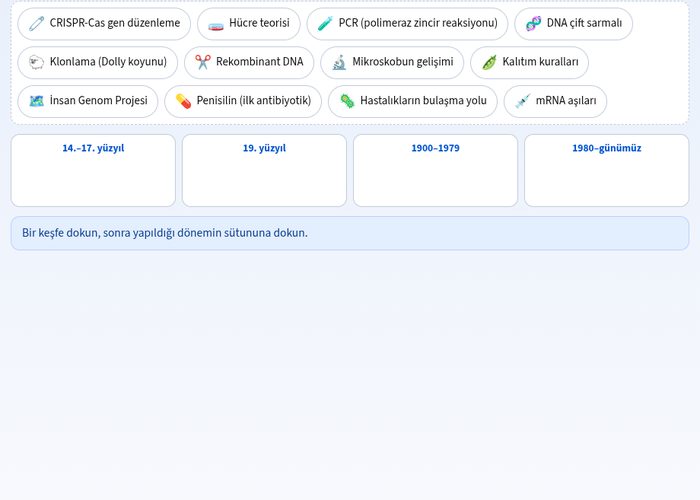
- You can place 12 important steps into the correct era, from the invention of the microscope to the DNA double helix and CRISPR-Cas gene editing technology.
- By tapping on the cards, you can read about the place of discoveries in human history and their fields of application.
- You can test your knowledge and check correct matches by answering questions guided by Raista.
Basic concepts and formulas
Biological science does not exist on its own; every invention builds upon those before it. For instance, Robert Hooke's observation of the cell in 1665 paved the way for Watson and Crick's discovery of the DNA double helix in 1953. Similarly, Kary Mullis's PCR (polymerase chain reaction) method or Doudna and Charpentier's CRISPR gene editing techniques could not have been developed without unraveling the structure of DNA.
How to use?
- Select a discovery card by tapping on it.
- Place the card by tapping on the appropriate column or related period box.
- Read their scientific contributions by tapping on the details of the placed cards.
- When you correctly place all discoveries, complete the timeline activity and return to the guide.
Frequently asked questions
Why is the development of biology studied using a timeline?
Because scientific discoveries are cumulative; every finding in the past (such as Mendel's laws of inheritance) forms the basis of future revolutionary technologies (like DNA and CRISPR).
What is CRISPR-Cas gene editing?
It is a modern biotechnology method developed by Doudna and Charpentier that allows making precise changes in DNA sequences.
What topics does this simulation cover?
- covers the historical development processes of life and biological science, which is the first theme of the grade biology curriculum.
 Interactive experiment