Water and minerals: surface tension with a coin, solubility test, water–oil heating experiment (high specific heat), floating ice; functions of minerals
Explore the vital properties of water and minerals for living things at interactive stations with the inorganic molecules simulation. Thanks to this inorganic molecules simulation, you can learn foundational biology topics such as the surface tension, cohesion, adhesion, high specific heat of water, and the functions of minerals in the body through hands-on practice. Learn by trying it right in your browser!
What can you do in this simulation?
You can observe the high specific heat capacity of water through the water and oil heating experiment.
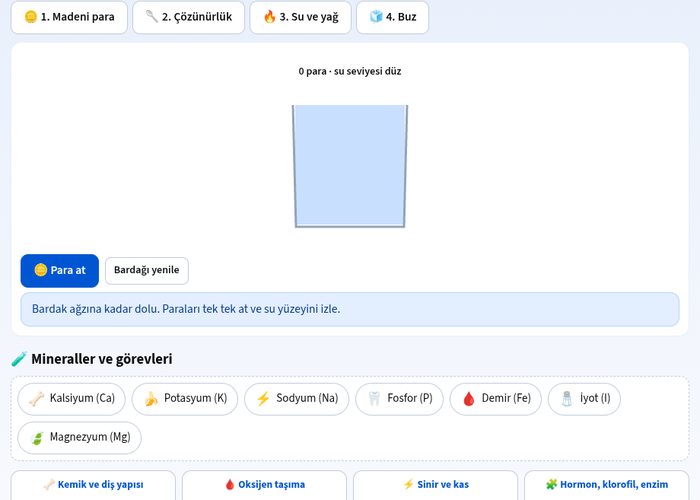
You can test the doming on the water surface, surface tension, and overflowing stages using a coin.
You can examine the expansion of water upon freezing and the floating of ice with the ice cube experiment.
You can match essential minerals such as calcium, iron, sodium, potassium, iodine, magnesium, and phosphorus with their respective functions.
With the help of the guide panel and question steps, you can save your predictions and get instant feedback.
Basic concepts and formulas
Inorganic substances, which are among the fundamental building blocks of living things, consist of water, minerals, acids, bases, and salts. They cannot be synthesized in the body and are taken ready from the outside. Water ensures that ecosystems and body temperature remain in balance thanks to its high specific heat. Cohesion and adhesion forces explain the intermolecular attraction of water and capillary action. Minerals, on the other hand, regulate metabolic activities by joining the structure of enzymes (as cofactors) and are stored in bone and tooth structures.
How to use?
Select the stations via the experiment panel and start the tests related to water and minerals in order.
Apply the solubility and surface tension steps using materials such as a coin, granulated sugar, and liquid oil.
Match the minerals with the correct boxes by dragging and dropping or tapping the cards.
Verify your predictions by pressing the check button and repeat the missing steps.
Frequently asked questions
Why is the specific heat of water important for living things?
The high specific heat of water ensures that water bodies and living bodies are resistant to temperature changes, helping protect life during sudden heat waves.
What functions do minerals undertake in the body of a living organism?
Minerals generally participate in the structure of enzymes as cofactors, ensure the hardening of bones, and play a direct role in nerve conduction and muscle contraction.
Why is water a good solvent?
Thanks to its polar structure, water easily dissolves polar molecules and ionic compounds; thus, it creates the liquid environment where metabolic reactions take place.
 Interactive experiment