Virtual laboratory: add Lugol's, Benedict's (by heating), Biuret, and Sudan III reagents to foods; determine the presence of starch, sugar, protein, and fat from color changes
With the Determination of Carbohydrates, Lipids, and Proteins in Foods simulation, you can test the basic organic compounds contained in the foods we consume in daily life in a virtual environment. Thanks to this interactive biology experiment, you will observe how basic nutrients such as starch, simple sugar, protein, and fat are detected using which reagents. Included within the scope of the 9th-grade biology course 1st theme life unit, this laboratory application allows you to learn organic molecule assay by practicing.
What can you do in this simulation?
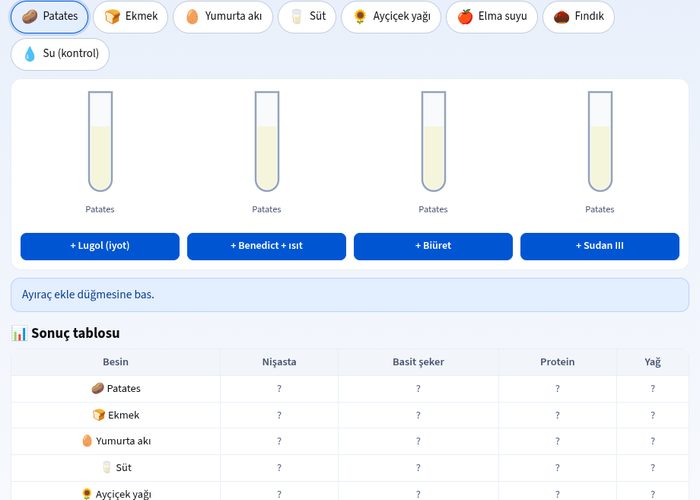
You can select different food samples such as milk, hazelnuts, starch, and simple sugar.
You can observe color changes by trying Lugol's, Benedict's, Biuret, and Sudan III reagents.
You can examine the brick-red precipitate by applying heating steps for Benedict's reagent.
You can completely fill out the nutritional contents table by completing a total of 32 different tests.
Basic concepts and formulas
Carbohydrates, lipids, and proteins found in the structure of living things are detected with specific chemical reagents. Lugol's solution creates a blue-purple color for starch. For simple sugars, Benedict's reagent gives a brick-red color when heated. While the Biuret reagent used for protein detection forms a purple color if protein is present in the medium, lipids (fats) form red-colored droplets or a layer with Sudan III.
How to use?
Choose a food and determine the organic molecule you want to examine.
Add the appropriate reagent (Lugol's, Benedict's, Biuret, or Sudan III) onto the food.
If necessary, follow the color change by applying the heating step.
Check the results and mark the correct options in the table.
Frequently asked questions
Which nutrient component does Lugol's reagent detect?
Lugol's reagent forms a blue-purple color in the presence of starch and is used in carbohydrate assay.
What color does the Biuret reagent give with protein?
When the Biuret solution interacts with protein, a distinct purple color appears.
Why is the Benedict's test heated?
Benedict's reagent requires heat energy to react with simple sugars and form a brick-red precipitate.
 Interactive experiment