Molecule workshop: link monomers via dehydration synthesis, separate them via hydrolysis; carbohydrates, lipids, proteins, nucleic acids, enzymes, and vitamins
Explore the fundamental building blocks of living things and the bonds between them interactively with the organic molecules simulation. You can observe the release of water while joining monomers via dehydration synthesis and learn how polymers are broken down through hydrolysis reactions.
What can you do in this simulation?
You can examine the formation processes of carbohydrates, lipids, proteins, and nucleic acids.
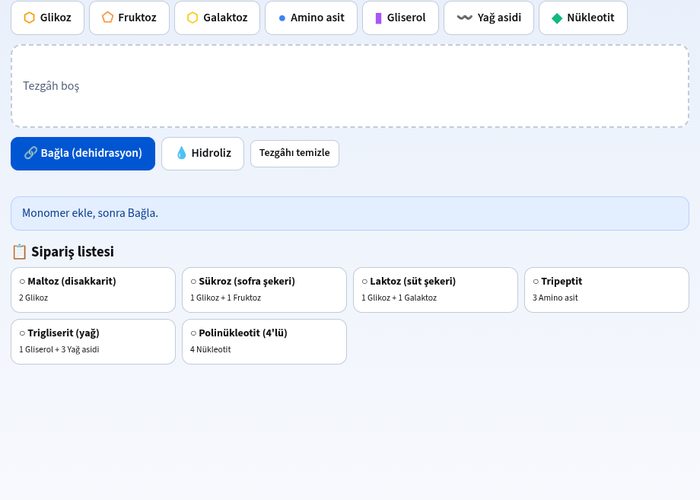
You can produce molecules such as maltose, sucrose, lactose, tripeptide, triglyceride, and polynucleotide in a workshop environment.
You can test reactions by dragging and dropping monomers such as glucose, amino acids, and nucleotides into the correct boxes.
You can observe the released water molecules by following the dehydration and hydrolysis steps.
You can discover how enzymes work as biological catalysts and their relationship with substrates.
Basic concepts and formulas
Organic compounds in the structure of living things are formed by small units called monomers establishing bonds among themselves. In dehydration synthesis, when n monomers combine, (n - 1) water molecules are released and bonds are formed (e.g., Glucose + Fructose -> Sucrose + H2O). In hydrolysis reactions, these bonds are broken down by consuming water.
How to use?
Go to the experiment panel and open the molecule workshop.
Choose among cards or monomers and drag and drop them into the appropriate boxes.
Complete orders and targets by starting dehydration or hydrolysis reactions.
Check the correct matches by reading the Raista mascot's guidance.
When all orders are ready, try different molecule groups again by using the restart button.
Frequently asked questions
Why is water released in a dehydration reaction?
When monomers bind to each other, a hydrogen (-H) group is detached from one and a hydroxyl (-OH) group from the other, and these combine to form a water molecule.
Are enzymes consumed in the reaction?
No, enzymes emerge from reactions unchanged and can be used repeatedly; they only affect the reaction rate and activation energy.
How many water molecules are released in triglyceride synthesis?
When a triglyceride molecule is formed, 1 glycerol and 3 fatty acids are bonded via ester bonds, and during this process, 3 water molecules are released.
 Interactive experiment