Science ethics: plagiarism, fabrication and falsification of data, informed consent, the 3R principles in animal experiments, ethics committee; evaluate research scenarios
With the science ethics simulation, you can learn core concepts such as plagiarism, data fabrication, informed consent, and the 3Rs principle in animal experiments through interactive scenarios. This application enables you to distinguish between correct and wrong behaviors in scientific research, understand the importance of ethical rules, and evaluate real-life cases.
What can you do in this simulation?
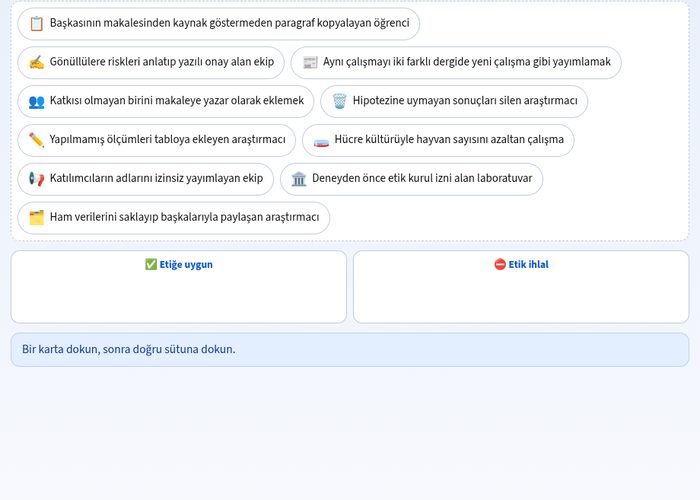
You can read various research scenarios to distinguish between correct and incorrect ethical behaviors.
You can place cards into the appropriate categories and boxes by dragging and dropping or by tapping.
You can test subjects such as plagiarism, data falsification, informed consent, and ethics committee approvals.
You can check your answers with the guidance of the mentor, go back to the questions you missed, and cover your gaps.
You can reset the simulation using the start over button and re-evaluate the scenarios.
Basic concepts and formulas
The reliability of scientific research depends on ethical rules. Plagiarism is using someone else's idea or writing without citation; data fabrication or falsification is altering results in a way contrary to reality. The 3Rs principle in animal experiments (Replacement, Reduction, Refinement) protects ethics. Obtaining informed consent is mandatory when working with human subjects.
How to use?
Carefully examine the research scenarios and cards on the experiment screen.
Make a match by tapping a card and then the correct box or column it belongs to.
Use the check button to verify your answers.
Review the steps you got wrong by examining the feedback.
When you complete all scenarios, repeat the exercise by pressing the start over button.
Frequently asked questions
What do research ethics violations include?
They include all behaviors contrary to scientific integrity such as plagiarism, data fabrication, data falsification, duplicate publication, and gift authorship.
What is informed consent?
It is the ethical process that ensures participants are informed about the risks, purpose, and procedures of the research and provide their voluntary written consent.
What is the 3Rs principle in animal experiments?
It is the principle aimed at protecting animal rights, formed by the initials of the words Replacement, Reduction, and Refinement.
 Interactive experiment