Uniform circular motion: whirl a ball attached to a string; calculate centripetal force with F = mv²/r using radius, velocity, and mass; tangential motion of the ball when the string is cut; maximum safe speed that friction can provide on a curve
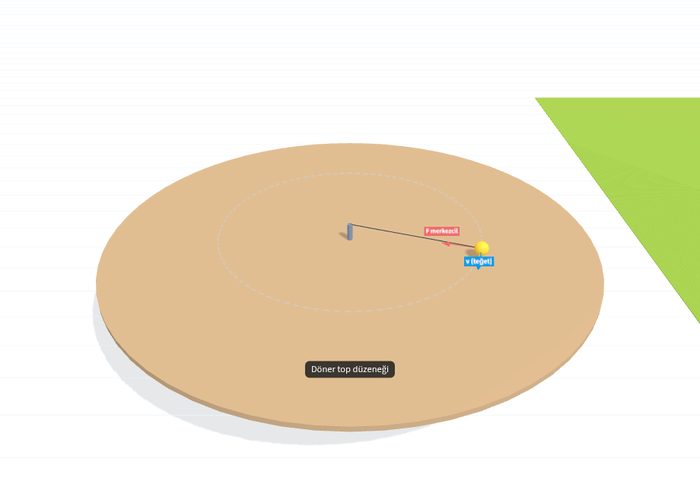
Explore the physical effects of changes in radius, velocity, and mass interactively by spinning a ball attached to a string with the uniform circular motion simulation. In this experiment, you will reinforce the concept of centripetal force and observe the ball moving in a direction tangent to the circle if the string is cut. Aimed at the force and motion unit of the 11th-grade physics curriculum, this tool allows you to easily understand the rules of circular motion in your browser.
What can you do in this simulation?
You can examine the basic dynamics of uniform circular motion by spinning a ball attached to a string.
You can observe the change in centripetal force by changing the radius, velocity, and mass parameters.
You can double the velocity and cut the string to test the object's movement in the tangential direction.
You can reinforce your theoretical knowledge by solving interactive questions accompanied by a guide.
Basic concepts and formulas
The magnitude of the velocity of an object in uniform circular motion remains constant, but since its direction changes continuously, an acceleration occurs. The factor providing this acceleration and force is the centripetal force directed towards the center. Our basic formula is F = m·v²/r, where F represents the centripetal force, m the mass, v the linear velocity, and r the radius of the circle.
How to use?
Open the simulation screen and take a look at the experiment and guide panel.
Start spinning the ball attached to the string and examine the parameters.
Observe F = m·v²/r calculations by changing velocity, mass, or radius values.
Try the object's motion in the direction tangent to the circle using the cut string option.
Test what you have learned by answering the questions in the guide.
Frequently asked questions
What is centripetal force?
Centripetal force is the net force that keeps an object in uniform circular motion on a circular path and is directed towards the center at all times.
Why doesn't the object go to the center if the string is cut?
When the string is cut, the force pulling towards the center disappears, and due to inertia, the object continues its motion in a direction tangent to its velocity vector at that moment.
How does the circular motion simulation work?
The simulation instantly calculates and visualizes the formula F = m·v²/r using the mass m, velocity v, and radius r values.
 Interactive experiment