Free fall: drop a feather and a hammer in air and in vacuum; measure fall times from different heights and find the acceleration due to gravity with g = 2h/t²; falling on the Moon and Mars; velocity–time graph
Discover the acceleration due to gravity with the free fall simulation, and learn the laws of motion by dropping a feather and a hammer in different environments.
What can you do in this simulation?
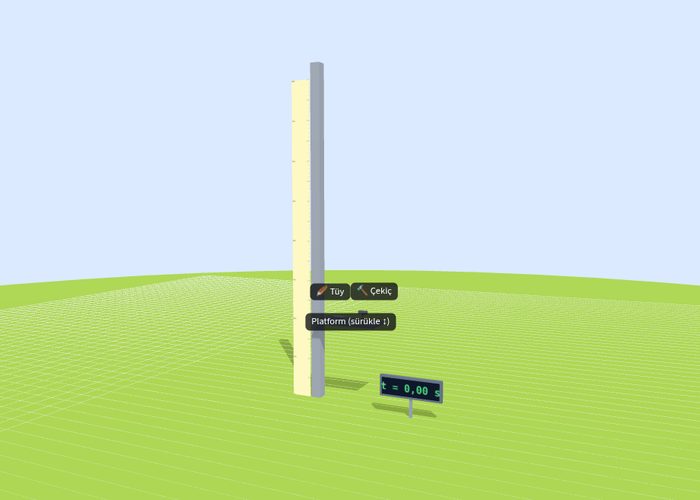
You can drop different objects like feathers and hammers in free fall in air and in a vacuum.
You can observe falling motion on different planets such as Earth, Mars, and the Moon.
You can measure fall times from different heights and examine the data.
You can track the motion of objects via the velocity-time graph.
You can reinforce your theoretical knowledge by answering questions accompanied by the guide.
Basic concepts and formulas
Free fall is the motion of an object under the influence of only gravity, independent of air resistance. In a vacuum, all objects fall with the same acceleration regardless of their mass. The basic formulas are:
Velocity: v = g·t
Distance: h = (1/2)·g·t²
Acceleration due to gravity: g = 2h/t²
How to use?
Determine the planet selection and environmental conditions (air/vacuum) from the experiment panel.
Select the object you want to drop (feather, hammer, etc.).
Adjust the height, release the object, and measure the fall time.
Make your calculations by examining the measurement results and the velocity-time graph.
Complete your experiment by answering the questions in the guide.
Frequently asked questions
Why do a feather and a hammer fall at the same time in a vacuum?
Because there is no air resistance in a vacuum environment and the acceleration due to gravity is independent of mass; therefore, all objects fall to the ground in the same amount of time.
How does the fall time change if the height increases by 4 times?
According to the formula, distance is proportional to the square of time with height (h ∝ t²). When the height increases by 4 times, the fall time increases by 2 times.
Is the acceleration due to gravity (g) the same everywhere?
No, the acceleration due to gravity varies depending on the mass and radius of the planets. For example, while it is approximately 9,8 m/s² on Earth, it takes different values on Mars and the Moon.
 Interactive experiment